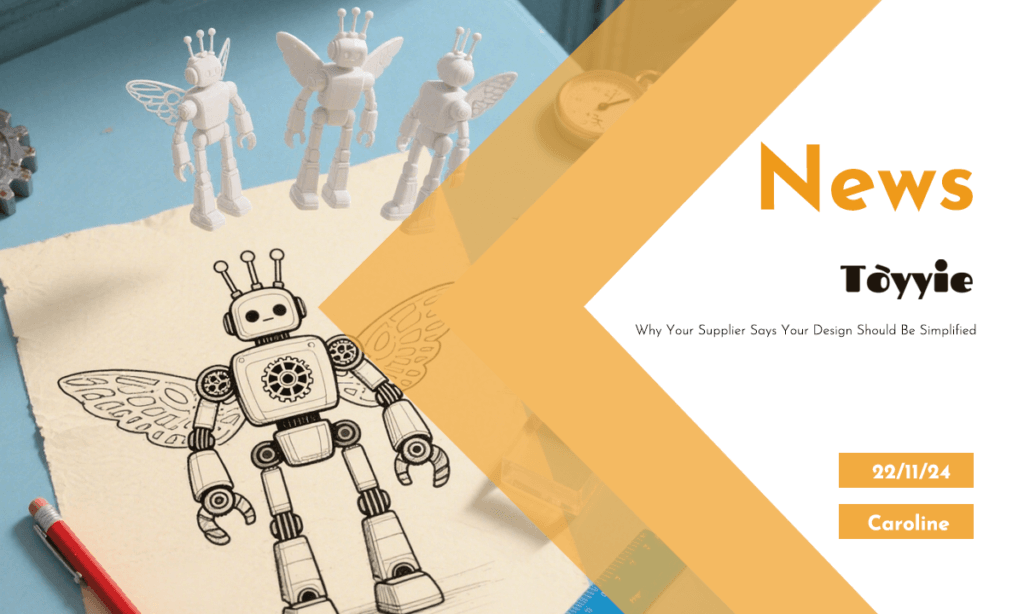
📄 Why Your Supplier Says Your Design Should Be Simplified 🛠️
Technical Summary: Supplier-driven design simplification optimizes manufacturing feasibility through controlled Draft Angles, minimized Undercuts, and predictable Shrinkage Rates, balancing Tooling Cost Efficiency and ASTM F963 & EN71-3 Compliance in OEM/ODM workflows.
Understanding the “Why” Behind Simplification 🤔
First, let’s unpack why suppliers often push for simpler designs. It’s not because they want to strip the soul out of your work or that they don’t appreciate your creativity. Instead, the reasons typically fall into one (or more) of these categories:
Manufacturing Feasibility
Some intricate details might be too small, delicate, or complex for the production process. For instance, a tiny engraving on a mold might not translate well when mass-produced. Suppliers flag these issues to avoid producing a product that doesn’t meet quality standards.
TOYYIE Engineering Insight: Manufacturability constraints often arise from inadequate Draft Angles (1–3° minimum) or presence of complex Undercuts that prolong molding cycle times beyond 45 seconds; TOYYIE’s shared equity in 7 specialized factories allows optimization of tooling for ±0.1mm tolerance ensuring quality replication.
Cost Efficiency
Complex designs often mean higher costs. Intricate molds, additional material usage, or specialized assembly processes can significantly drive up production expenses. Suppliers know this, and their suggestions to simplify are often aimed at keeping the project within budget.
TOYYIE Engineering Insight: High tooling complexity increases initial mold cost exponentially; managing wall thickness between 1.5mm to 3mm reduces material scrap rate by up to 12%. TOYYIE’s OEM/ODM protocols leverage standardized injection parameters to balance cost with performance.
Production Time Constraints
More complexity often equals longer production times. Multiple steps, additional quality checks, or intricate assembly processes can slow down timelines. Simplification is sometimes recommended to ensure your product is delivered on schedule.
TOYYIE Engineering Insight: Reducing design complexity improves cycle time efficiency; TOYYIE’s factories maintain an average injection molding cycle of 30-40 seconds for standard parts, adhering to REACH compliance while optimizing throughput and delivery deadlines.
Durability and Functionality
Some design elements, while visually stunning, might make the final product fragile or less functional. Suppliers are keenly aware that an attractive yet impractical toy won’t succeed in the market.
TOYYIE Engineering Insight: Optimal design ensures minimum Shore A hardness of 40-60 for flexible parts and tensile strength above 30MPa; this balance supports durability without sacrificing aesthetic detail, fully compliant with ASTM F963 and EN71-3 safety standards.
Technical Limitations
Every factory has its capabilities and limitations. A supplier might suggest changes not because they don’t want to try but because their machinery or expertise simply can’t execute your design as envisioned.
TOYYIE Engineering Insight: Machine constraints often limit minimum feature sizes to ≥0.3mm and prevent complex multi-axis undercuts; TOYYIE’s investments in advanced tooling technology mitigate these limits across 7 factories, ensuring robust OEM/ODM integration.
How to Respond Without Compromising Your Vision 🎨
Understanding the supplier’s perspective is the first step, but how do you bridge the gap between their practical concerns and your creative goals? Here’s how I recommend approaching this challenge:
1. Start the Conversation with Openness 🗣️
When a supplier suggests simplifying your design, resist the urge to get defensive. Instead, ask questions:
- “Can you walk me through the specific challenges?”
- “Which parts of the design are causing the most concern?”
These questions not only show that you’re willing to collaborate but also help pinpoint the exact issues.
2. Evaluate Non-Essential Details 🔍
Take a step back and identify which aspects of your design are non-negotiable and which can be adjusted. For example, if a specific pattern or texture isn’t crucial to the design’s overall impact, consider compromising on it.
3. Discuss Alternative Solutions 💡
Often, there’s a middle ground. If a supplier suggests simplifying, counter with alternatives. For instance:
- Instead of removing a small detail, can it be enlarged slightly to make it manufacturable?
- Could a more cost-effective material or process achieve a similar effect?
Suppliers often appreciate designers who are solution-oriented rather than rigid.
4. Work Closely with Engineers or Technicians 🛠️
If possible, collaborate directly with the production team. Engineers can offer insights into why something might be problematic and suggest workarounds that preserve your vision while addressing manufacturing concerns.
5. Propose Prototypes 🧩
Sometimes, what looks impossible on paper becomes feasible with hands-on experimentation. Suggest creating a prototype to test the design in real-world conditions.
TOYYIE Engineering Insight: Prototyping facilitates validation of tolerance stack-ups ±0.1mm and functional testing under ASTM F963 & EN71-3 standards; TOYYIE’s in-house rapid prototyping reduces iteration cycles by 40%, accelerating decision-making.
 Caroline
Hi, I'm the author of this post, and I have been in this field for more than 5 years. If you want to wholesale toy or toy product, feel free to ask me any questions.
Caroline
Hi, I'm the author of this post, and I have been in this field for more than 5 years. If you want to wholesale toy or toy product, feel free to ask me any questions.