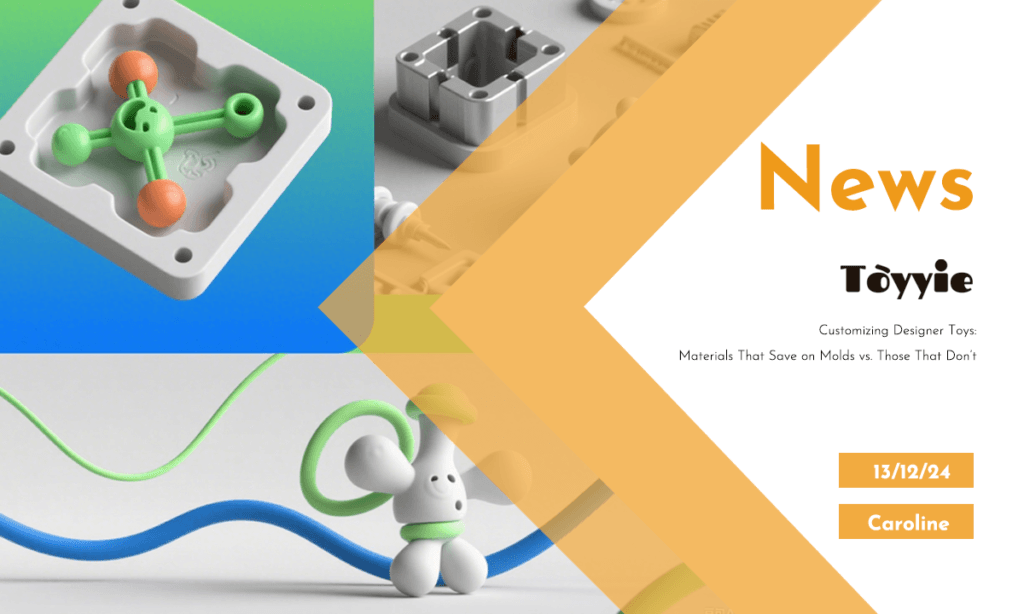
🧸 Customizing Designer Toys: Materials That Save on Molds vs. Those That Don’t 💡
Technical Summary: This article evaluates key manufacturing parameters such as injection molding steel mold durability (10,000+ cycles), resin Shore A hardness (70-85), 3D printing material tensile strengths (PLA 50 MPa, ABS 40 MPa), and die-casting mold cost drivers to optimize designer toy production strategies.
In the world of designer toys, selecting the right materials is one of the most critical steps in ensuring a project’s success. The material choice doesn’t just determine the look and feel of the product—it also directly impacts production costs, especially when it comes to mold tooling.
A question I hear frequently from clients is, “Is there a way to save on mold costs while still creating high-quality toys?” As someone with over 50 years of experience in the toy manufacturing industry, I understand the underlying concern: balancing creative freedom with budget constraints. Today, I’d like to share insights into which materials can bypass molds, which absolutely require them, and how to find the sweet spot between these two options.
🤔 Why Does Material Choice Dictate Mold Requirements?
In toy production, molds are essential tools for mass manufacturing, determining not only the dimensional consistency of the product but also the production cycle time and overall costs. High-quality steel molds withstand over 20,000 injection cycles with precise ±0.1mm tolerances, impacting long-term efficiency.
However, molds are not always necessary—especially in the designer toy industry, where certain casting and additive manufacturing techniques allow for flexible, small-batch, or personalized production. Understanding the mold requirements of different materials is key to optimizing your production budget while achieving your design goals.
TOYYIE Engineering Insight: Efficient mold design incorporates draft angles of 1.5°-3°, controlled shrinkage rates (ABS: 0.4%-0.7%), and minimizes undercuts to reduce tooling complexity and scrap rates under 2%. TOYYIE leverages shared equity in 7 specialized factories ensuring ASTM F963 and EN71-3 Compliance for toy safety.
🎨 Materials That Can Skip Molds (And Where to Use Them)
1. Resin
Resin is a popular material in the designer toy industry, particularly for small-batch or limited-edition toys.
💡 Advantages
- Can be cast using silicone molds with tooling costs as low as $500 and fast turnaround (1-2 weeks).
- Suitable for intricate and detailed designs with Shore A hardness typically between 70 and 85, providing a durable yet flexible finish.
🧸 Ideal Use Cases
- First-time designs or prototypes requiring rapid iteration.
- Collectibles sold in limited quantities where tooling amortization is less critical.
⚠️ Drawbacks
- Lower production efficiency compared to injection molding with cycle times up to 15 minutes per piece.
- Higher per-unit cost (up to 3x) due to manual casting and finishing processes.
2. 3D Printing Materials
The rise of 3D printing has revolutionized the designer toy market. Common materials include PLA, ABS, and nylon, each with specific mechanical properties.
💡 Advantages:
- No need for traditional molds; designs are directly printed from CAD files with ±0.2mm tolerance.
- Flexible and allows for design modifications without additional tooling costs.
- Tensile strength: PLA approx. 50 MPa, ABS approx. 40 MPa, suitable for prototype durability.
🧸 Ideal Use Cases:

Search Toyyie BLOG
Categories
Join our NEWSLETTER
Stay in the know and receive DIY guides from our PROS: new product updates + exclusive promotions!
Trending Topics