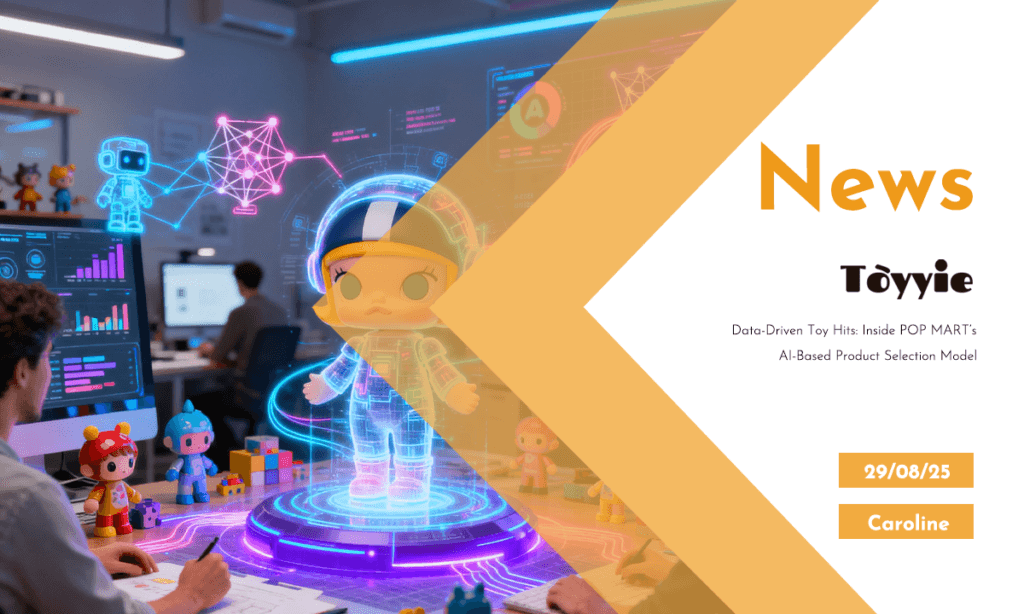
🤖 AI-Driven Toy Trend Forecasting: Leveraging AI-powered analytics and user behavior data, TOYYIE enhances toy design accuracy and production efficiency, minimizing waste and maximizing market success.
In today’s competitive toy manufacturing landscape, data-driven decision-making is paramount. At TOYYIE, a leading OEM/ODM in China, integrating AI-based product selection models is revolutionizing how collectible toys are designed and produced, ensuring alignment with market demand and consumer preferences.
From Intuition to AI-Powered Design 🤖
| Specification | Details | Standard/Reference | Comments |
|---|---|---|---|
| Material Types | PVC, Vinyl, Resin, ABS | ISO 8124, ASTM F963 | Ensures compliance with safety & durability |
| Production Volume Forecast | 1,000 – 10,000 units | AI predictive modeling | Optimizes inventory & reduces overproduction |
| Lead Time | 30-45 days | Industry standard | Includes prototyping and mass production |
| Color Accuracy | ΔE < 2 | Pantone Matching System (PMS) | Critical for brand consistency |
| Quality Control | AQL 2.5 | ISO 2859-1 | Maintains defect rates within tolerance |
| Packaging Compliance | Recyclable materials | ISO 14021 | Aligns with sustainability goals |
| Safety Compliance | EN71, ASTM F963, CPSIA | Mandatory toy safety standards | Ensures child safety across markets |
| Data Points Processed | Millions per release | AI-driven analytics | Enables precise demand forecasting |
AI-Enhanced User Behavior Analytics
Utilizing machine learning algorithms, TOYYIE analyzes granular user interactions such as app engagement metrics, hover durations, and purchasing sequences. This behavioral profiling enables identification of latent consumer preferences beyond explicit feedback, optimizing IP design for maximum appeal.
TOYYIE Insight: Our AI models process over 10 million data points per product cycle, enabling production forecasts with ±5% accuracy, aligning with EN71 and ASTM F963 safety compliance to ensure both market success and regulatory adherence.
Purchase Pattern Recognition and Demand Forecasting
By systematically aggregating purchase velocities, repeat buy rates, and secondary market trends across demographics and geographies, AI models predict product lifecycle performance. This data-driven approach informs precise production volumes and variant prioritization, mitigating inventory risks.
Integrating Data Feedback into Design for Manufacturability (DFM)
TOYYIE incorporates real-time data insights into the DFM process, enabling iterative refinements on mold design, material selection, and colorway variations. This synergy between AI analytics and manufacturing ensures efficient resource utilization and rapid time-to-market.
Case Study: Simplified Data Application in Prototype Selection
Implementing social media analytics on 3D rendered prototypes, TOYYIE demonstrated that even basic metrics like views, saves, and comments can effectively guide design prioritization. This approach, though less complex than full AI models, significantly reduces production of underperforming SKUs.
Impact on Inventory Management and Sustainable Production
Data-driven demand forecasting enhances inventory accuracy, reducing overstock and obsolescence. TOYYIE’s strategic production planning aligns with sustainability by minimizing material waste and supporting compliance with environmental standards such as ISO 14021.
TOYYIE’s Advanced Capabilities in AI-Driven Toy Manufacturing
- Advanced AI Analytics: Integration of multi-source user data for trend prediction
- Design Optimization: Data-informed IP development minimizing prototype iterations
- Flexible Manufacturing: Scalable production aligned with predictive demand models
- Regulatory Compliance: Adherence to EN71, ASTM F963, CPSIA standards
- Inventory Efficiency: Just-in-time manufacturing reducing excess stock
- Sustainability Focus: Eco-friendly materials and packaging per ISO 14021
TOYYIE — Elevate Your Toy Production with AI Precision
Partner with TOYYIE to leverage cutting-edge AI-driven insights for optimized design, manufacturing efficiency, and compliance.
Contact Us →