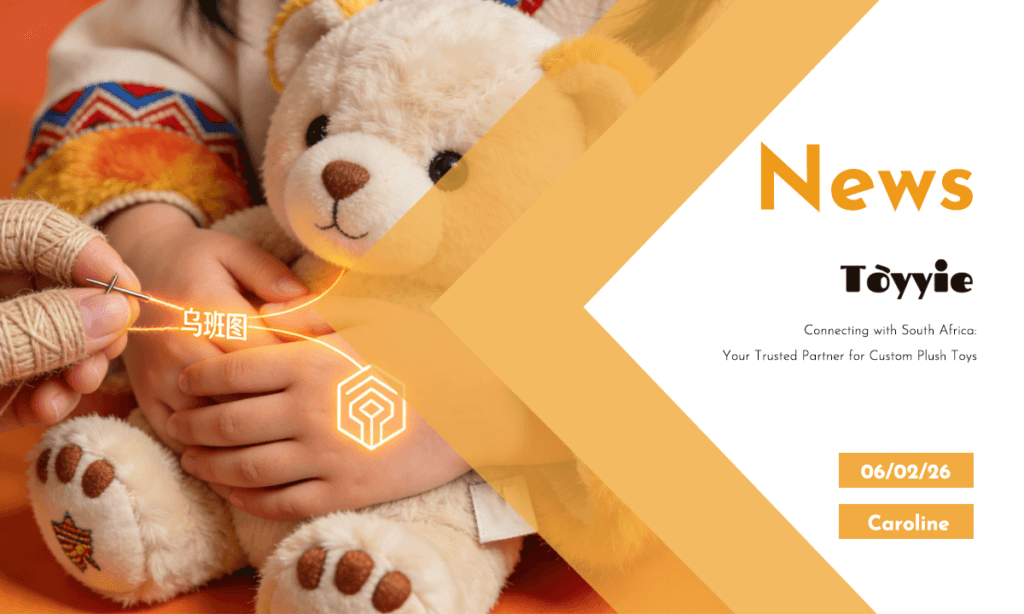
🧸 Custom Plush Toys Tailored for South Africa: TOYYIE delivers precision-engineered custom plush toys integrating local cultural elements, climate-adaptive materials, and rigorous safety compliance for the South African market.
As a leading OEM/ODM in premium plush toy manufacturing, TOYYIE combines over a decade of technical expertise with deep cultural insights to craft custom plush toys that resonate authentically with South African consumers. Our approach emphasizes material innovation, design collaboration, and regulatory compliance to ensure each product embodies quality and cultural relevance.
🌍 Understanding South African Market Needs
| Specification | Requirement | Recommended Material/Process | Compliance Standard |
|---|---|---|---|
| Fabric Breathability | High airflow & moisture wicking | Cotton blend with UV-resistant finish | ISO 105-B02 (Colorfastness to light) |
| Stuffing Durability | Retains loft in humid coastal regions | Polyester fiberfill with anti-microbial treatment | ASTM F963 Section 4.3.5 |
| Safety Components | No small detachable parts for toddlers | Embroidered eyes replacing plastic components | SANS ISO 8124-1 |
| Color Palette | Culturally relevant warm earth tones | Dyes matching Ndebele art-inspired swatches | OEKO-TEX Standard 100 |
| Stress Point Reinforcement | Enhanced seam strength at limbs | Double stitching with reinforced backing fabric | ASTM F963 Section 4.4.4 |
| Material Weight | Lightweight for ease of handling by children | Fabric weight approx. 180-220 g/m² cotton blends | ISO 3801 |
| Environmental Adaptability | UV and humidity resistance | UV-tested dyes and moisture-resistant stuffing | ISO 4892-3 |
| Labeling | Multilingual tags including isiZulu | Sewn-in fabric tags with safe inks | EN 71-1 |
Cultural Customization with Technical Precision
TOYYIE employs collaborative design workflows integrating South African cultural motifs such as Ndebele patterns and Karoo sunset palettes. Our technical teams translate these inspirations into fabric swatches and embroidery techniques that maintain authenticity while ensuring manufacturing feasibility and durability.
TOYYIE Insight: Our plush toys meet and exceed SANS ISO 8124-1 safety standards, utilizing embroidered eyes instead of plastic components for toddler lines, reducing choking hazards effectively.
Material Selection Optimized for the South African Climate
Considering South Africa’s diverse climate, TOYYIE selects breathable cotton blends treated with UV-resistant dyes and stuffing materials engineered to resist coastal humidity. This ensures plush toys remain comfortable, hygienic, and retain their shape over time.
TOYYIE Insight: We implement UV-tested dye processes conforming to ISO 105-B02 to ensure colorfastness under South African sunlight exposure, preserving aesthetic integrity during prolonged use.
Enhanced Safety Engineering Beyond Compliance
TOYYIE rigorously applies SANS ISO 8124 standards and ASTM F963 guidelines, proactively eliminating potential hazards such as small detachable parts. Features like embroidered eyes and reinforced stress points anticipate real-world usage by children, providing superior safety and longevity.
Iterative Co-Creation and Localized Testing
Our development process incorporates feedback loops with South African illustrators and educators, facilitating culturally nuanced co-creation. Prior to mass production, physical prototypes undergo localized testing to refine ergonomics, stitching softness, and cultural details, ensuring market acceptance.
Manufacturing Excellence with Transparent Communication
TOYYIE commits to transparent project management, including real-time video demonstrations of stitching tests and deadline-aligned adjustments. This client-focused communication assures quality control and fosters trust throughout the production lifecycle.
TOYYIE’s Advanced Plush Toy Manufacturing Capabilities
- Precision Fabric Sourcing: Customized textile blends tailored for climate and cultural accuracy
- Advanced Stitch Reinforcement: Double-stitching and stress point backing for enhanced durability
- Collaborative Design Integration: Partnerships with local South African creatives for authentic cultural representation
- Safety-First Engineering: Compliance with SANS ISO 8124 and ASTM F963 standards with proactive hazard mitigation
- Localized Prototyping and Testing: Physical sample validation with client and regional stakeholder feedback
Partner with TOYYIE for South African Custom Plush Toys
Leverage our technical expertise and cultural insights to deliver premium, compliant plush toys that authentically connect with South African children and families.
Request a Custom Sample →