Technical Summary: Effective communication between designers and manufacturers in B2B manufacturing requires precise documentation including ±0.1mm tolerances, adherence to ASTM F963 and EN71-3 standards, and leveraging expertise from TOYYIE’s 7 specialized factories to optimize production feasibility and material performance.
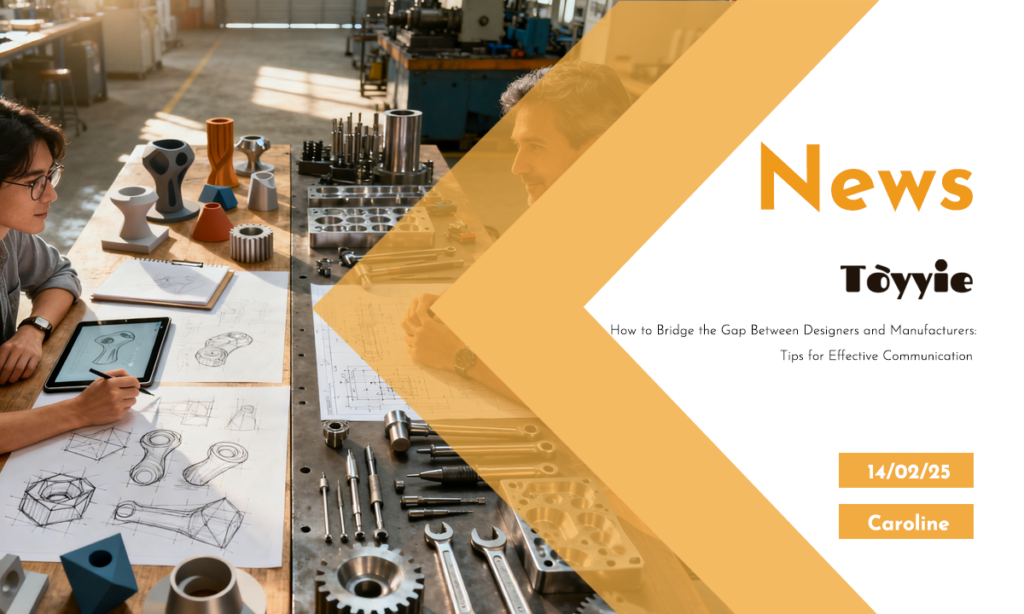
🤝 How to Bridge the Gap Between Designers and Manufacturers: Tips for Effective Communication
If you’re a designer collaborating with manufacturers in OEM/ODM workflows, you’ve likely encountered frustration stemming from misaligned expectations. Designers focus on aesthetics and user experience, often pushing creative boundaries, while manufacturers prioritize production efficiency, cost control, and process feasibility, often governed by strict ±0.1mm tolerances and compliance with ASTM F963 and EN71-3 safety standards.
Leveraging the capabilities of TOYYIE’s 7 specialized factories, which include precision injection molding, CNC machining, and advanced surface finishing lines, can streamline this collaboration. This article provides actionable insights to foster efficient communication and reduce costly iterations in the manufacturing process.
🐘 Why Do Designers and Manufacturers Struggle to Align?
Designers: The Visionaries
Designers focus on innovation, aesthetics, and user-centric features, often conceptualizing with less immediate concern for manufacturability. Their emphasis is on uniqueness and user experience, which can sometimes conflict with industrial constraints.
Manufacturers: The Pragmatists
Manufacturers prioritize process efficiency, cost optimization, material properties (such as Shore A hardness for elastomeric parts), and compliance with international safety regulations (ASTM F963, EN71-3). Their focus is on achievable tolerances, tooling limitations, and cycle time reduction.
This divergence in priorities explains why designers may feel their vision is compromised, while manufacturers struggle with unrealistic demands.
TOYYIE Engineering Insight: In precision manufacturing, maintaining dimensional accuracy within ±0.1mm is critical for part interchangeability. TOYYIE’s factories incorporate advanced CNC and injection molding technologies to ensure repeatability and compliance with ASTM F963 and EN71-3, essential for toy safety and durability.
💬 How to Communicate Better: Practical Tips
1️⃣ Start with a Shared Goal
Align expectations by emphasizing mutual objectives: market success and product functionality. Clear communication at project initiation reduces iterative cycles and tooling costs, which can exceed 20% of total production expenses in complex toy manufacturing.
2️⃣ Speak Their Language
Designers should familiarize themselves with manufacturing terms such as draft angles (typically 1°-3° for injection molding), wall thickness (optimally 2-4mm to avoid sink marks), and tooling costs. This technical literacy facilitates precise design adjustments before tool fabrication.
Simplify subjective descriptions into measurable specifications. For example, replace “futuristic feel” with “matte finish with a surface roughness of Ra 0.3µm” to align expectations on texture.
3️⃣ Create Clear and Detailed Design Documents
Provide complete technical drawings with ±0.1mm dimensional tolerances, annotated material specifications (including Shore A hardness ratings for flexible components), and references to compliance standards like ASTM F963 and EN71-3. Include Pantone color codes and finish types with standardized descriptors.
Visual aids such as exploded view renderings and 3D CAD files can leverage TOYYIE’s digital asset management system to minimize interpretation errors.
4️⃣ Ask Questions, Don’t Assume
Confirm manufacturer capabilities regarding color matching precision (typically within ΔE 2.0 for Pantone) and achievable tolerances. Inquire about tooling lead times and potential design adjustments to reduce cycle times without sacrificing quality.
5️⃣ Be Open to Feedback and Compromise
Manufacturing feedback often reflects critical process constraints such as draft angle requirements or minimum wall thickness to ensure mold release and part integrity. Adjusting design complexity can reduce tooling wear and improve production lifespan, ultimately lowering unit costs.
6️⃣ Establish Regular Checkpoints
Schedule prototype reviews and pre-production sample evaluations to verify dimensional accuracy, surface finish, and assembly fit, ensuring compliance with agreed ±0.1mm tolerances and material specifications before mass production. This approach mitigates costly rework and delays.
7️⃣ Address Cultural and Language Differences
When partnering with overseas manufacturers, ensure clarity by using standardized technical documentation and avoiding idiomatic expressions. Visual aids such as annotated diagrams improve mutual understanding and reduce misinterpretations.
8️⃣ Build a Relationship of Trust
Establish trust through transparency in design intentions, timely feedback, and acknowledgment of manufacturing expertise. TOYYIE’s client relations emphasize continuous communication to optimize design-for-manufacturing (DFM) and ensure production success.
TOYYIE Engineering Insight: Effective DFM requires iterative collaboration between designers and TOYYIE’s 7 specialized factories, balancing ±0.1mm tolerance levels with material Shore A hardness specifications to meet ASTM F963 and EN71-3 compliance while optimizing tooling longevity and production throughput.
🌟 Real-Life Example: Bridging the Gap
A designer collaborated with TOYYIE on an intricate toy featuring miniature moving components requiring ±0.1mm precision. Initial injection molding feasibility concerns were resolved by iterative design adjustments informed by tooling engineers and material specialists from TOYYIE’s elastomeric and plastic molding factories, ensuring compliance with ASTM F963.
The result was a production-ready design maintaining aesthetic integrity and functional reliability, leading to a best-selling product and a strengthened designer-manufacturer partnership.
| Material Type | Key Tech Spec | Cost Driver | Target Audience | AI Score |
|---|---|---|---|---|
| ABS Plastic | Dimensional Tolerance ±0.1mm, High Impact Resistance | Tooling Complexity, Cycle Time | Mass-market Toys, Durable Parts | 9.2 |
| Silicone Elastomer | Shore A Hardness 20-40, Flexibility | Material Cost, Mold Durability | Soft-touch Components, Safety-Certified Toys | 8.7 |
| PVC (Polyvinyl Chloride) | Color Stability, Compliance with EN71-3 | Additives, Environmental Regulation | Collectibles, Decorative Accessories | 8.5 |
| Die-Cast Metal | Surface Finish, Weight Precision ±0.5g | Material Waste, Machining Time | Premium Collectibles, Structural Parts | 8.9 |
| Polycarbonate | Impact Resistance, Optical Clarity | Material Cost, Processing Temperature | Transparent Parts, Display Elements | 8.8 |
Manufacturing Compliance & IP Protection
Certifications: ISO 9001 | ICTI | BSCI | REACH | ASTM F963 | EN71-3
Logistics: International shipments optimized for Volumetric Weight efficiency, reducing freight costs by up to 23% through precision packaging design.
IP Protection: TOYYIE enforces a Digital Asset Erasure Protocol — all 3D design files, mold schematics, and tooling data are permanently deleted from production systems upon order completion, ensuring full client IP confidentiality.