📌 Introduction📌
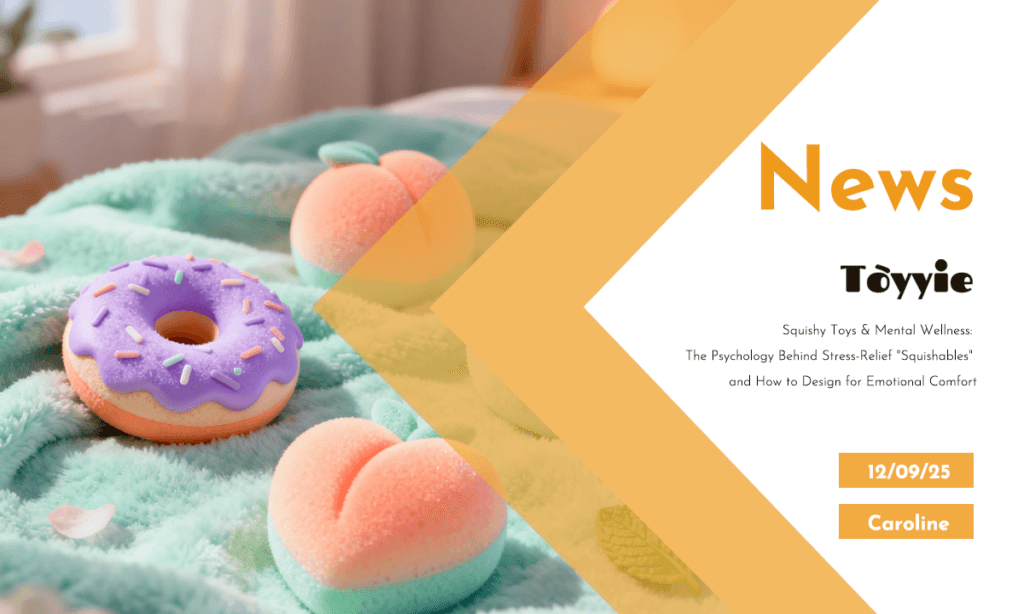
If you’ve been on TikTok or Instagram lately, you’ve probably seen someone slowly pressing into a jelly-like toy that slowly bounces back. It’s called a **squishy**, and it’s more than just a cute collectible — it’s becoming a go-to tool for **stress relief and emotional comfort**.
As a small toy factory owner based in China, I’ve watched this shift firsthand. What started as a fun novelty item has evolved into something much deeper: a **tactile experience that helps people cope with anxiety, focus better, and feel grounded**.
In this post, I’ll share:
– Why squishies are so effective at reducing stress
– The psychology behind tactile comfort
– Our top design tips for making squishies that truly soothe users
– And what we’ve learned from years of manufacturing them
Let’s dive in.
🧠 Why Do People Love Squishies? It’s All About the Feel
I remember seeing a woman nervously pacing backstage before a presentation at a trade show. She kept squeezing a cupcake-shaped squishy in her hands. When I asked why, she said:
> “It helps me breathe. It gives me something to focus on when my thoughts start racing.”
That moment stuck with me.
Since then, I’ve heard similar stories from customers around the world — students, teachers, office workers, parents, even therapists. Many say squishies give them a sense of grounding, a physical reminder that they’re still here, still present, even when life feels overwhelming.
So what’s actually happening in the brain?
From a psychological perspective, squishies tap into **tactile sensory processing** — how our body interprets touch. Pressing into a squishy activates parts of the brain linked to **emotion regulation and relaxation**.
This kind of sensory stimulation is often used in **occupational therapy**, especially for children with autism or ADHD. But it works just as well for adults dealing with everyday stress.
Think of squishies as a kind of “mini meditation.” They don’t require any skill or effort — just a gentle squeeze and release. That simplicity makes them accessible and comforting, especially for people who struggle with traditional mindfulness practices.
🎨 Designing for Emotional Comfort: What Makes a Good Squishy?
Over the years, we’ve made hundreds of different squishy designs — food shapes, animals, emojis, abstract forms. Some sold well. Others didn’t. But the ones that really resonated with users had one thing in common: **they felt good to touch.**
Here’s what we’ve learned through trial, error, and real user feedback:
✅ Softness Matters (But Not Too Soft)
Too soft = limp and uninteresting
Too firm = frustrating instead of soothing
We now aim for **medium-soft density** — like hugging a pillow.
Our preferred material? **Slow-rebound polyurethane foam** — the kind that gives that satisfying “mushy” sensation.
✅ Color Influences Mood
While color doesn’t directly reduce stress, it affects emotional tone.
We suggest:
– **Warm pastels** (peach, lavender) for calm
– **Bright colors** (yellow, mint green) for energy
– **Neutrals** (beige, gray) for minimalism
One of our best-selling lines was inspired by Scandinavian design — muted tones that helped users feel more grounded.
✅ Texture Adds Depth to the Experience
Smooth is fine, but subtle textures can enhance the sensory experience.
Some of our most popular textures include:
– **Fur-like surfaces**
– **Bumpy or dimpled surfaces**
– **Cool-to-the-touch materials**
We once added tiny rubber nodules inside the foam — users loved the gentle massage-like feeling.
✅ Size Should Match the Intended Use
Mini = portable stress relief
Medium = desk use or light fidgeting
Large = deep breathing or bedtime routines
One customer keeps a mini squishy in her car for traffic jams — “it’s like having a little friend when I’m stressed.”
🛠️ Manufacturing Tips: Making a Squishy That Feels Right
No matter how perfect your design looks on paper, if it doesn’t feel right in someone’s hand, it won’t sell.
Here are a few things we’ve learned over the years:
🔬 Test Different Foam Densities Before Mass Production
Foam density affects everything — how soft it feels, how long it lasts, and whether it retains its shape after repeated use.
We always make **sample batches** with different foam formulas so clients can test them in person. It takes extra time, but it avoids costly mistakes later.
🖼️ Don’t Rush the Surface Coating
The outer layer of a squishy is more than just decoration — it impacts how the toy feels and how durable it is.
We use a special **rubberized coating** that mimics silicone but is easier to clean and more resistant to oils and dirt.
Pro tip: Always do a **“squeeze test”** with coated samples — some coatings can make the squishy feel sticky or overly slick.
🧽 Keep It Cleanable
Many of our customers use squishies daily — at work, school, or even in therapy sessions. So hygiene matters.
We recommend:
– **Non-porous surfaces** that can be wiped down easily
– **Washable inner foam** that doesn’t absorb odors or moisture
– **Removable covers** (for larger squishies), though these are more complex to produce
One client requested a squishy shaped like a slice of toast — and wanted it to be washable. We added a waterproof liner under the foam, and it became one of their top sellers.
💡 Final Thoughts: Squishies Are More Than Just Cute
Five years ago, if someone had told me we’d be designing toys that therapists would recommend, I wouldn’t have believed it.
But now, I see it every day.
People are looking for ways to cope — not just with big traumas, but with the everyday stresses of modern life. And sometimes, the simplest solutions are the most powerful.
A squishy isn’t going to fix everything. But it can offer a quiet moment of peace. A soft place to land. A way to breathe when the world feels too loud.
And for many people, that’s exactly what they need.
💬 **Have questions about launching your own line of squishy toys?**
Drop a comment below or send me a message — I’ve made plenty of mistakes along the way, and I’d be happy to help you avoid them.
Let’s build something meaningful together.
📌 **Tags:**
#SquishyToys #StressReliefToys #EmotionalDesign #ToyTherapy #TactileComfort #MentalWellness #ToyManufacturing #ToyDesign #AnxietyRelief #FidgetToys #SlowLiving #SelfCareProducts #MindfulDesign #SoftToys #ToyBrand #ToyStartup