If you’re a designer or brand owner in the US or Europe, you’ve probably considered manufacturing your toy or collectible in China. The cost benefits are real. But so are the risks.
I’ve worked in toy manufacturing here for over a decade. And the most painful thing I see? A beautiful design from a Western creator — full of soul, story, and detail — turning into something that feels cheap, off-brand, or just… wrong.
It’s not sabotage. It’s not laziness. It’s translation failure — not in language, but in intent.
Here are the 5 most common traps — and how to avoid them.
🔹 Trap 1: Assuming “Manufacturing” Means “Execution Only”
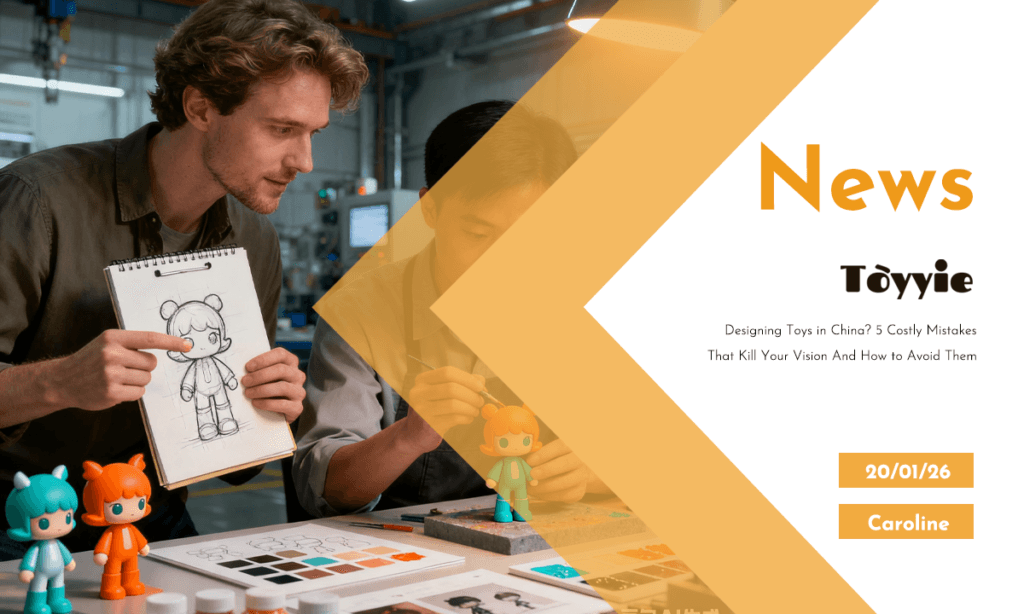
Many designers hand over a 3D file and say: “Make this.”
But manufacturing isn’t just about copying. It’s about interpreting.
Example: You design a character with soft, rounded edges to feel friendly. But in mold‑making, sharp corners are easier and cheaper. So the factory “simplifies” the curves — without telling you.
The result? A blander, more generic figure.
How to fix it:
- Mark critical details in your design: “This curve must stay soft.”
- Use reference photos, not just files. Show the feel you want.
- Say: “I don’t mind paying more to keep this detail.”That changes the entire conversation.
But it adds depth, texture, and that “wow” when light hits the edges.
Perfect for gifting, limited editions, or retail displays.
🔹 Trap 2: Not Understanding Material Limits
You pick a translucent blue for your character’s cloak — meant to look like ice. But the factory uses a standard “clear blue” resin because it’s in stock.
Result? It looks like cheap plastic, not magic.
Materials behave differently in real life. What works in a 3D render doesn’t always translate to actual resin, paint, or fabric.
How to fix it:
- Ask for physical samples of color and finish — never just digital swatches.
- Test glow-in-the-dark, metallic, or UV‑reactive paints in person.Some look amazing in daylight but dull under indoor light.
- Understand that “translucent” isn’t one thing:
🔹 Trap 3: Ignoring the Cultural “Filter”
- Your character has big, shiny eyes — meant to express wonder.But in mass production, the factory increases eye size slightly to make molding easier.To you: it looks soulless.To them: it’s “cleaner.”Worse:You use a symbol (dragon, lotus, etc.) with deep meaning in your story.But locally, it’s seen as generic “Asian decor.”The nuance gets lost completely.How to fix it:
- Treat cultural details like engineering specs: document them.
- Say:“This dragon isn’t evil. It’s wise. So the expression should be calm, not fierce.”
- Use mood boards with Western references:“Think Studio Ghibli, not cheap Halloween toy.”
🔹 Trap 4: Skipping the Prototype Phase (or Rushing It)
Some brands skip physical samples to save time or money. Big mistake.
We once had a client who approved only a 3D render. When the first batch arrived:
- paint chipping
- resin cloudy
- base too small → kept tipping over
Fixing it cost more than three rounds of samples would have.
How to fix it:
- Always do at least one physical prototype.
- Test it like a real user: hold, display, gently drop.
- Check paint durability, balance, and how it looks in natural light.
🔹 Trap 5: Treating the Factory Like a Vendor, Not a Partner
The best outcomes happen when the factory gets your vision — not just your file.
One designer came to us with a forest spirit protecting a dying tree. She didn’t just send a model — she shared her sketchbook, inspiring music, even a short video of the character in her mind.
Our team felt it. And it showed: subtle bark texture, soft green glow in the eyes, the whole mood.
How to fix it:
- Share your why, not just your what.
- Say:“This character is lonely but hopeful. How can the pose show that?”
- Ask the factory:“What would you do differently to make this feel more alive?”
💡 Final Thought: Manufacturing Is Co-Creation
Your design has a soul. But that soul doesn’t survive by accident.
It survives when you:
- communicate clearly
- respect the craft
- treat your factory as a creative partner — not just a tool
If you’re serious about your brand: Don’t just “make it in China.” Make it right in China.
And if you’ve been burned before? You’re not alone. Most of us have. The key is learning how to speak the same language — beyond just words.
Have you had a design go wrong in production? I’d love to hear your story — and help you avoid it next time.