Why Understanding the Production Timeline is Critical for B2B Success
In the competitive OEM/ODM toy sector, timing is not just a logistical detail—it is a financial strategy. Whether you are preparing for a Q4 holiday launch, a Kickstarter fulfillment, or a corporate promotional event, a single week’s delay in the Production Schedule can lead to missed retail windows, increased air freight premiums, and lost revenue.
Understanding the “Why” behind each phase allows brands to manage expectations with stakeholders and identify opportunities for Lead Time Compression. In 2026, the integration of AI-assisted pattern making and automated laser cutting has streamlined parts of the process, yet the fundamental “human-in-the-loop” nature of plush assembly remains the primary pacing factor.
The Complete 2026 Plush Production Timeline: A Phase-by-Phase Breakdown
A professional plush toy project follows a linear progression with specific “Gateways” that must be cleared before moving to the next stage.
Phase 1: Design and Prototyping (2–4 Weeks)
This is the most iterative phase of the timeline. It transforms a 2D character sheet into a 3D physical form.
- Concept Review (3 Days): Engineering check for “Sewability.” Can the character’s limbs be turned inside out? Are the proportions stable?
- Initial Prototype (7–10 Days): The “Rough Sample.” Using “in-stock” fabrics to verify shape and volume.
- Refinement & “Golden Sample” (7–10 Days): Incorporating specific Pantone-matched fabrics, custom Embroidery, and final accessories.
- Technical Insight: 2026 standards prioritize Sublimation Printing for complex patterns, which can add 3 days to the prototyping cycle compared to standard solid-color fabrics.
Phase 2: Material Sourcing and Lab Testing (2–3 Weeks)
Once the Golden Sample is approved, the factory must secure the “Bulk Materials.”
- Fabric Procurement (7–14 Days): Standard plush fabrics (Super Soft Velboa, Minky) are usually in stock. However, custom-dyed fabrics or eco-friendly RPET (Recycled PET) materials may require a 14-day lead time from the mill.
- Safety Lab Testing (7 Days): Critical for CPSIA (USA) and EN71 (EU) compliance. Samples are sent to third-party labs (SGS, ITS, BV) to test for lead, phthalates, and physical “Pull Tests” on small parts like safety eyes.
Phase 3: Pre-Production & Tooling (1–2 Weeks)
- Cutting Dies & Templates: Creating the “Steel Dies” for the hydraulic press or programming the CNC Laser Cutters.
- Embroidery/Printing Setup: Digitizing the embroidery files and creating the “Hoops” for multi-head embroidery machines.
- Test Batch (Pilot Run): Producing the first 50–100 units to calibrate the assembly line and verify the Yield Rate.
Phase 4: Mass Production (4–8 Weeks)
This is the “Engine Room” of the timeline. The duration depends heavily on the Order Quantity (MOQ) and design complexity.
- Cutting & Embroidery (1 Week): High-speed automated phase.
- Sewing & Assembly (2–5 Weeks): The most labor-intensive phase. A 5,000-unit order with complex multi-panel construction requires significant “Man-Hours.”
- Stuffing & Closing (1 Week): Using specialized fiber-fill machines and final hand-stitching.
- Metal Detection: Every plush toy must pass through a high-sensitivity metal detector to ensure no broken needles remain inside.
Phase 5: Quality Control and Packaging (1 Week)
- In-Line Inspection: Checking stitching tension during assembly.
- Final Random Inspection (FRI): Based on AQL 2.5/4.0 standards.
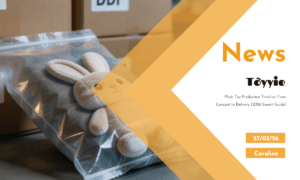
- Vacuum Packaging: In 2026, 80% of plush toys are vacuum-packed to reduce Volumetric Weight by up to 60%, significantly lowering shipping costs.
Phase 6: Logistics and Delivery (1–6 Weeks)
- Air Freight (3–7 Days): Fast but expensive. Best for small batches or urgent restocks.
- Sea Freight (30–45 Days): The most cost-effective for bulk orders.
- DDP (Delivered Duty Paid): A “Hands-Off” logistics model where the factory handles all customs, duties, and final-mile delivery.
2026 Production Schedule Decision Matrix
| Order Size | Prototyping | Production | Shipping (Sea) | Total Lead Time | Strategy |
|---|---|---|---|---|---|
| Small Batch (100–500) | 2 Weeks | 3 Weeks | 1 Week (Air) | 6 Weeks | Use for market testing. |
| Mid-Sized (1k–5k) | 3 Weeks | 5 Weeks | 5 Weeks | 13 Weeks | Standard retail cycle. |
| Bulk (10k+) | 4 Weeks | 8 Weeks | 6 Weeks | 18 Weeks | Optimized for lowest COGS. |
Factors That Influence Your Lead Time
1. Design Complexity (The “Stitch Count”)
A simple “Round Mascot” has 4–6 fabric panels. A complex “Anime Character” can have 30+ panels and intricate embroidery. Every additional panel adds approximately 0.5 to 1.5 minutes of sewing time per unit. Across 5,000 units, this adds 125 labor hours.
2. Seasonal Peak Demand
Factories operate on a “First-In, First-Out” basis. The “Golden Window” for production is February to July. Orders placed in September or October face “Holiday Congestion,” where lead times can swell by 20%–30%.
3. Material Availability (The “Fabric Roll” Factor)
If your design requires a specific “Long-Pile Faux Fur” that is currently out of fashion, the factory must wait for a “Minimum Dye Lot” from the fabric mill, which can add 21 days to the start of production.
4. Quality Standards (EEAT Signals)
Higher quality requirements (e.g., ISO 9001 audited facilities) involve more rigorous “Gate-Checks.” While this adds 3–5 days to the timeline, it reduces the risk of a “Mass Recall” which could destroy a brand’s reputation.
Expedited Production: Possibilities and Costs
Can you “Skip the Line”? Yes, but it comes with a technical price.
- Rush Fee (15%–30% Premium): This covers overtime labor (Night Shifts) and “Line Pre-emption” costs.
- Air Freight Pivot: The most effective way to save 30 days is to switch from Sea to Air.
- Pre-Sourcing Materials: At TOYYIE, we maintain a “Material Buffer” for our regular clients, allowing us to skip the 14-day sourcing delay.
The TOYYIE Efficiency Advantage: How We Compress the Timeline
At TOYYIE, we act as your Supply Chain Orchestrator. We don’t just manage a factory; we optimize a system.
- Concurrent Engineering: We begin the Material Sourcing and Safety Lab Testing while the final prototype is being refined, saving 10–14 days.
- Digital Pattern Approval: Using 3D visualization to reduce the number of physical sample rounds.
- Logistics Integration: Our DDP network ensures that “Customs Clearance” is handled in parallel with transit, avoiding port delays.
Manufacturing Compliance & IP Protection
A structured timeline is also a “Security Timeline.”
- Milestone Verification: Every stage of the timeline is documented with photos and QC reports.
- Digital Asset Erasure: Post-production, all embroidery files and cutting templates are moved to secure offline storage to prevent unauthorized “After-Market” runs.
- Global Safety: We ensure that the Safety Testing phase is never skipped, protecting you from legal liability in the US and EU markets.
Action Call: Get Your Detailed Production Schedule
Don’t leave your launch date to chance. TOYYIE provides a custom Project Gantt Chart for every inquiry. Contact our team today to map out your 2026 production journey.
Time is Money. Let’s Optimize Both.
Upload your design today for a free timeline consultation and a transparent, data-driven quote.