The Strategic Importance of the Manufacturing Agreement
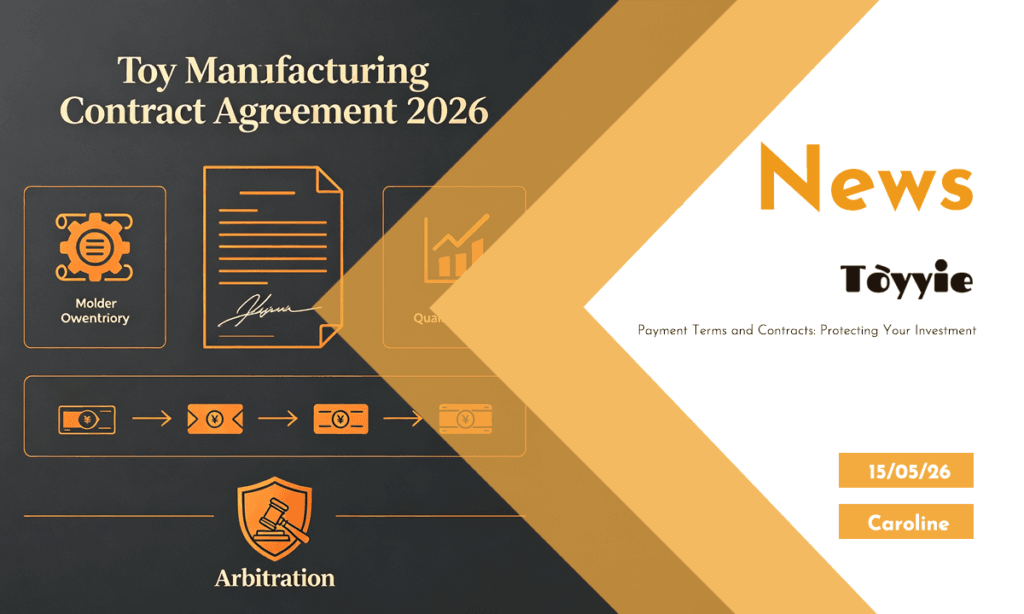
In the B2B toy sector, a contract is not just a legal formality; it is the Technical Specification for your business relationship. In 2026, global supply chains are characterized by high volatility in material costs and stricter regulatory oversight (e.g., the EU 2025/2509 Toy Safety Regulation). Without a robust Manufacturing Agreement (MA), your “Quote” is merely a suggestion, not a binding obligation.
At TOYYIE, we believe that transparency is the foundation of trust. Our 12-year heritage is built on a “Contract-First” philosophy, ensuring that every project has a clear roadmap for payment, quality, and delivery, protecting both the creator’s capital and the brand’s reputation.
Common Payment Terms: The 2026 Industry Standard
The way you pay determines your leverage. In 2026, the industry has shifted away from “100% Upfront” models toward Milestone-Based Financing.
1. The 30/70 Standard (Traditional OEM)
- 30% Deposit: Paid to confirm the order and initiate raw material procurement (PVC, ABS, Resin).
- 70% Balance: Paid after the final FQC (Final Quality Control) report is approved but before the goods leave the factory gate (FOB) or upon arrival at the port (CIF/DDP).
2. Tooling & NRE (Non-Recurring Engineering)
Mold costs are typically handled separately from unit production.
- 50/40/10 Structure: 50% upfront to start mold design; 40% upon approval of T1 (Trial 1) Samples; and the final 10% upon approval of the “Golden Sample” and mold handover.
- Technical Tip: Ensure your contract explicitly states that you own the physical mold once the final 10% is paid.
3. Escrow and Trade Assurance
For new partnerships in 2026, many brands use Escrow Services (like Alibaba Trade Assurance or independent legal escrow). Funds are held by a third party and only released once the AQL 2.5/4.0 inspection report is uploaded and verified.
Essential Contract Clauses: The “Safety Net”
A professional toy manufacturing contract must address four critical engineering and business risks.
Quality Thresholds (Linked to EN 71-1:2026)
Your contract should not just say “High Quality.” It must define quality using international standards.
- AQL (Acceptable Quality Level): Define the limits for Critical (0%), Major (2.5%), and Minor (4.0%) defects.
- Rejection Clause: If the batch fails the AQL inspection, the manufacturer is contractually obligated to re-work or replace the units at their own cost.
Delay Penalties (The “Late Fee”)
In the toy industry, missing a “Retail Window” (like Christmas or a movie launch) can be fatal.
- Penalty Structure: A common 2026 standard is a 0.5% to 1.0% reduction in the total order value for every day of delay beyond the “Contractual Ship Date,” capped at 10%.
- Grace Period: Typically, a 3-7 day grace period is allowed for unforeseen logistics minor delays.
Mold Ownership & Retention
The mold is the “DNA” of your product.
- Ownership: The contract must state that the client owns the mold, the 3D files, and the CAM toolpaths.
- Retention: Define how long the factory will store the mold for free (usually 2 years of inactivity) and the protocol for transferring the mold to a different facility if needed.
Intellectual Property (IP) & Digital Security
- Work-for-Hire: Explicitly state that all design modifications made by the factory engineers are “Work-for-Hire” and belong to the client.
- Digital Erasure: In 2026, TOYYIE includes a Digital Asset Erasure clause, requiring the factory to delete all 3D files from production-line machines once the run is complete.
Risk Management Matrix (2026)
| Risk Factor | Contractual Solution | Financial Impact |
|---|---|---|
| Material Cost Surge | Price Locking (90-day window) | Prevents mid-project “Price Creep” |
| Quality Failure | AQL-Linked Final Payment | Ensures factory accountability |
| IP Theft | Mold Batch-Coding & NDA | Protects $30B+ in brand value |
| Late Delivery | Tiered Penalty Clauses | Protects retail launch windows |
Dispute Resolution: CIETAC vs. HKIAC
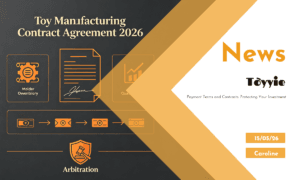
When disputes arise in 2026, “Going to Court” in a foreign country is often too slow. Most professional B2B toy contracts specify Arbitration.
- CIETAC (China): The standard for manufacturing in Mainland China. It is efficient and the awards are enforceable in 160+ countries under the New York Convention.
- HKIAC (Hong Kong): Often preferred by Western brands for its English-language proceedings and common-law heritage.
- TOYYIE’s Approach: We recommend CIETAC (Shenzhen/Shanghai) for its deep understanding of industrial manufacturing nuances.
The TOYYIE Transparent Contract: Your Investment Partner
At TOYYIE, we don’t hide behind fine print. Our 12-year heritage is built on the “Clean Contract” model.
- Bi-Lingual Agreements: All our contracts are provided in both English and Chinese, ensuring no “Lost in Translation” errors in technical specs.
- Transparent Cost Breakdown: We show you the real cost of materials, labor, and tooling, allowing for a fair and sustainable partnership.
- Proactive Compliance: Our contracts are updated quarterly to reflect the latest CPSC eFiling (July 2026) and EU DPP requirements.
Manufacturing Compliance & IP Protection
A contract is only as good as the Audit Trail behind it.
- Documented QC: Every batch we produce is accompanied by a QC Inspection Certificate that links directly to the payment milestone.
- Secure Escrow Support: We support multiple secure payment platforms to give our international clients 100% peace of mind.
Invest with Confidence. Produce with Precision.
Protect your IP and your capital with TOYYIE’s transparent, data-driven manufacturing agreements.
References
- ODM vs OEM vs Contract Manufacturing: The 2026 Payment Guide
- China Manufacturing Agreement: The Playbook for Production (2026 Edition)
- The Guide to Molds and Tooling in International Manufacturing Contracts
- B2B Payment Terms Every Seller Should Know in 2026
- EN 71-1:2026 Mechanical and Physical Safety Updates for Contracts