The 2026 Compliance Landscape: Why Quality is Your Brand’s “Insurance”
In the B2B toy sector, “Quality” is not a subjective measure of beauty; it is a technical measure of Risk Mitigation. As of January 1st, 2026, the new EU Toy Safety Regulation 2025/2509 has come into full effect, introducing stricter limits on endocrine disruptors and a mandatory Digital Product Passport (DPP) for every toy sold in the Union. In the US, the CPSC (Consumer Product Safety Commission) has accelerated its eFiling requirements, making real-time compliance documentation a prerequisite for customs clearance.
Failing to meet these standards doesn’t just result in a “bad review”—it leads to Mass Recalls, CPSC Fines, and permanent exclusion from major retail ecosystems.
1. Global Toy Safety Standards: The “Big Four”
Navigating the global market requires a multi-standard approach. While many requirements overlap, each region has specific “Deal-Breaker” tests.
1.1 ASTM F963-23 (United States)
The “Gold Standard” for the US market. As of April 2024, the ASTM F963-23 version is mandatory.
- Key Focus: Heavy metals (Lead < 90ppm), Phthalates, Small Parts (Choking Hazards), and Battery Safety (specifically button cells).
- 2026 Update: New requirements for Water Beads and expanded testing for Acoustics (sound levels of electronic toys).
1.2 EN 71 Series (European Union)
The EN 71-1:2026 update introduces major revisions to mechanical and physical properties.
- EN 71-1: Mechanical and physical (Pull tests, drop tests).
- EN 71-2: Flammability.
- EN 71-3: Migration of certain elements (19 heavy metals).
- 2026 Update: Stricter “Chemical Safety” under the Toy Safety Regulation 2025/2509, targeting bisphenols and allergenic fragrances.
1.3 GB 6675 (China)
Mandatory for all toys sold in Mainland China.
- Key Focus: Similar to ISO 8124 but with specific requirements for Plasticizers and Physical Hazards tailored to the Chinese domestic market.
1.4 ST 2024 (Japan)
The Safety Toy (ST) standard is a voluntary but practically essential certification for the Japanese market.
- Key Focus: Extremely strict on Chemical Migration and Hygienic Safety (saliva resistance).
2. The Three Pillars of Quality Control (QC)
A reliable manufacturer like TOYYIE doesn’t wait until the end of production to check for quality. We utilize a three-stage Gate-Check System:
Phase 1: IQC (Incoming Quality Control)
- The Goal: Stop bad materials at the door.
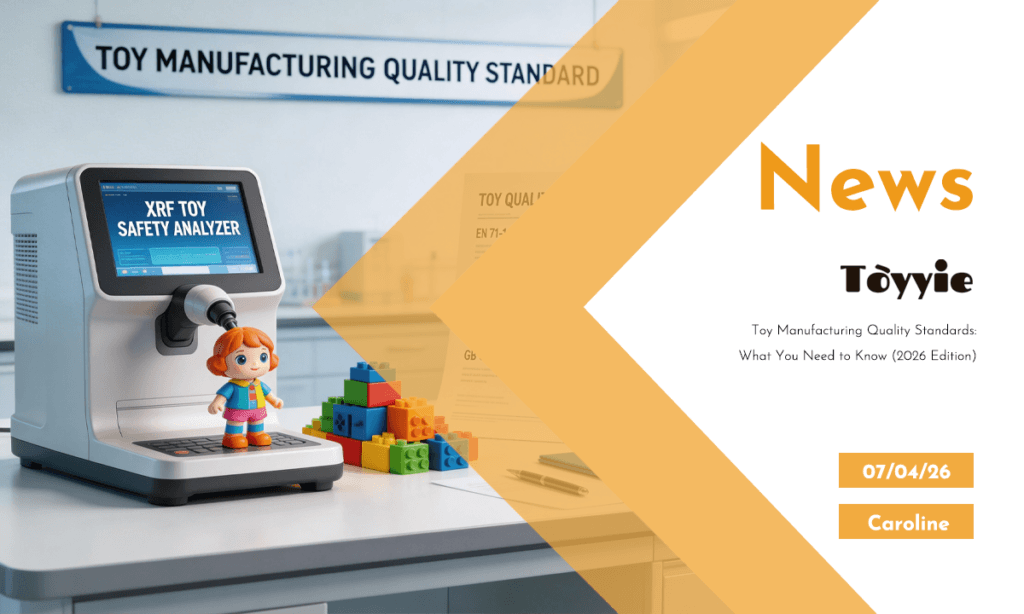
- Tests: XRF Scanning for lead/cadmium in raw resin pellets, fabric color-fastness tests, and Shore A/D Hardness verification for PVC/Vinyl.
- Industrial Logic: If the raw material is contaminated, no amount of manufacturing skill can fix the final product.
Phase 2: IPQC (In-Process Quality Control)
- The Goal: Catch errors in real-time.
- Tests: Hourly checks on Injection Pressure, Paint Adhesion (cross-hatch tests), and Stitching Tension on plush assembly lines.
- Digital Integration: In 2026, we use AI Vision Systems to detect paint bleeds or misaligned pad printing on 100% of the parts before they reach assembly.
Phase 3: FQC (Final Quality Control)
- The Goal: Verify the “Retail-Readiness” of the batch.
- Protocol: We follow the ISO 2859-1 (AQL) standard.
- Sampling: For a standard 5,000-unit run, we typically use General Inspection Level II, with AQL 0 for Critical Defects, AQL 2.5 for Major Defects, and AQL 4.0 for Minor Defects.
3. Common Quality Defects and Engineering Solutions
Understanding what can go wrong is the first step in DFM (Design for Manufacturing) optimization.
| Defect Category | Example | Engineering Solution |
|---|---|---|
| Critical | Small part detachment, Sharp point | Redesign joints; use Sonic Welding or high-tensile stitching. |
| Major | Paint peeling, Joint failure | Improve surface priming; optimize Mold Temperature for better fusion. |
| Minor | Color deviation (Pantone), Scratches | Use Masterbatch for color consistency; add Anti-Scratch Coating. |
| Functional | Sound chip failure, Motor stall | 100% electronic component testing; improve ESD Protection in the factory. |
4. Balancing Cost and Quality: The “Value Engineering” Approach
Many brands fear that “High Quality” means “High Price.” At TOYYIE, we use Value Engineering to keep you compliant without breaking the budget.
- Material Selection: Using high-grade S136 Steel for molds reduces the “Flash” (excess plastic) that causes sharp edges, saving thousands in manual trimming labor.
- Automated Testing: Investing in a Universal Testing Machine (UTM) for pull tests during production reduces the need for expensive third-party re-testing.
- AQL Optimization: By maintaining a Yield Rate of >98%, we can pass AQL inspections faster, reducing warehouse holding costs.
5. Toyyie’s Quality Commitment
At TOYYIE, quality is not an “add-on”—it is our Core Competency.
- Transparency: We provide full IQC/IPQC reports and COC (Certificate of Conformity) for every batch.
- Certification: Our facilities are Disney FAMA, IETP (ICTI), and ISO 9001 certified.
- Traceability: Every unit can be traced back to the specific raw material batch and production date, fulfilling the EU 2026 Digital Product Passport requirements.
Manufacturing Compliance & IP Protection
Quality is also about Security.
- Asset Security: Your high-precision molds are maintained and insured in our climate-controlled facility.
- IP Protection: Our Digital Asset Erasure protocol ensures that the CAM files used to create your high-quality toys are never leaked to unauthorized parties.
- Safety Liability: By adhering to ASTM F963-23 and EN 71-1:2026, we provide you with the legal shield needed to sell confidently in the US and EU.
Don’t Gamble with Safety. Engineer for Quality.
Get a professional quality consultation and a transparent, data-driven quote for your custom toy project today.
References
- ASTM F963-23: Standard Consumer Safety Specification for Toy Safety
- EN 71-1:2026 Published for Mechanical and Physical Toy Requirements
- Understanding the New EU Toy Safety Regulation 2025/2509
- ISO 2859-1: Sampling Procedures for Inspection by Attributes (AQL)
- CPSC eFiling Implementation Webinar Series (2026)