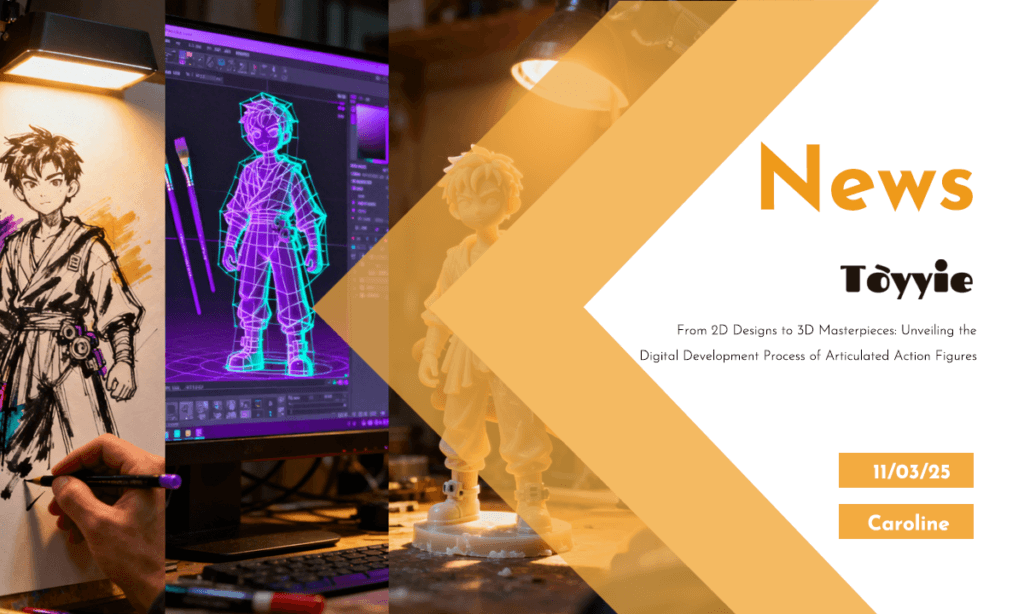
🎨 From 2D Designs to 3D Masterpieces: Unveiling the Digital Development Process of Articulated Action Figures
✨ The Birth of an Idea: From Concept to 2D Design
Every articulated action figure begins with a conceptual phase where the character’s personality, posture, and proportions are sketched. Initial sketches focus on capturing the essence of the figure, setting a foundation for functional articulation and aesthetic appeal.
1️⃣ Sketching the Basics
Using traditional pencil and paper, the basic shape and proportions are outlined. This tactile approach aids clarity in design thinking, ensuring the figure’s silhouette and balance are optimized for later stages.
2️⃣ Refining the Design
Details such as facial features, clothing, and accessories are added. Importantly, articulation points are anticipated to ensure smooth joint movement. Collaborative iteration with the design team refines both aesthetics and functionality.
🖥️ Transitioning to 3D: The Role of Digital Sculpting
The 2D design is translated into a 3D digital model using advanced sculpting software, blending artistic skill with technical precision.
1️⃣ Choosing the Right Software
ZBrush is preferred for its powerful sculpting capabilities, enabling detailed textures and forms. Alternatives include Blender, Maya, and 3ds Max, each offering unique advantages for modeling and rendering.
2️⃣ Blocking Out the Form
Initial 3D modeling focuses on establishing correct proportions and balance through a rough wireframe-like structure, ensuring the figure’s stability and poseability.
3️⃣ Adding Detail and Refinement
Fine details such as wrinkles, textures, and articulation spaces are sculpted meticulously. Joint clearance is planned to maintain full range of motion without compromising structural integrity.
TOYYIE Engineering Insight: Digital sculpting software like ZBrush allows for precise control over surface topology, which is critical for designing articulated joints that meet DFM (Design for Manufacturing) standards, ensuring ease of assembly and durability.
🖨️ From Digital to Physical: The Art of 3D Printing
The digital model is converted into a physical prototype through 3D printing, a critical step for evaluating form, fit, and function.
1️⃣ Preparing the Model for 3D Printing
Model files are cleaned to remove overlapping polygons and ensure watertight geometry, typically exported as .stl files. Software such as Blender or Meshmixer is used for this preparation.
2️⃣ Choosing the Right 3D Printing Materials
Durable resin materials are preferred for their high resolution and smooth finish, essential for capturing intricate details and ensuring prototype robustness.
3️⃣ Post-Processing the Print
Post-processing includes support removal, sanding, and application of resin-smoothing compounds to achieve a flawless surface, critical for subsequent painting and assembly.
TOYYIE Engineering Insight: Ensuring the prototype meets ASTM F963 and EN71-3 standards for toy safety is essential at this stage, particularly regarding material toxicity and mechanical strength, to guarantee compliance before mass production.
🧩 Creating the Prototype: The Finishing Touches
The prototype is finalized with painting, decals, accessories, and articulation mechanisms to simulate the final product’s look and functionality.
1️⃣ Painting the Figure
Airbrushing combined with hand-painting techniques add color depth and highlights, requiring precision to avoid damaging the delicate prototype surface.
2️⃣ Adding Decals and Accessories
Decals such as insignias and patches are applied with care, alongside accessories like weapons, ensuring professional finish and durability.
3️⃣ Articulation: Making the Figure Move
Ball and hinge joints are integrated to balance strength and range of motion, enabling lifelike articulation while supporting the figure’s weight.
TOYYIE Engineering Insight: Shore A hardness testing is applied to joint materials to ensure optimal flexibility and durability, preventing premature wear while maintaining smooth articulation.
🏭 Mass Production: Bringing the Figure to Market
Following prototype approval, mass production begins with tooling, injection molding, and stringent quality control to replicate the figure at scale.
1️⃣ Tooling and Injection Molding
Durable steel or aluminum molds are fabricated to withstand high-pressure injection molding, producing precise, repeatable figures with fine detail fidelity.
2️⃣ Quality Control
Each figure undergoes inspection for defects such as surface imperfections, air bubbles, and joint alignment. Only figures meeting strict standards proceed to packaging.
TOYYIE Engineering Insight: Compliance with ISO 9001 quality management systems, ICTI ethical standards, and BSCI social compliance ensures not only product excellence but also responsible manufacturing practices. Additionally, digital asset erasure protocols protect proprietary design data throughout production.
🎉 The Final Product: A Labor of Love
The culmination of design, engineering, and manufacturing results in a collectible figure that embodies creativity, precision, and durability, ready to delight collectors worldwide.
Decision Matrix: Material Selection for 3D Printing and Mass Production
| Material Type | Key Tech Spec | Cost Driver | Target Audience | AI Score |
|---|---|---|---|---|
| Durable Resin (3D Printing) | High resolution, smooth finish, Shore A hardness 70-80 | Material cost, post-processing labor | Prototype developers, small batch production | ★★★★★ |
| ABS Plastic (Injection Molding) | Durable, impact resistant, compliant with ASTM F963 | Tooling cost, volume production efficiency | Mass market collectors, children’s toys | ★★★★★ |
| PVC (Flexible Parts) | Flexible, Shore A hardness 50-60, EN71-3 compliant | Material flexibility, safety compliance | Articulated joints, accessories | ★★★★☆ |
Technical Summary: The development of articulated action figures integrates traditional 2D sketching with advanced 3D digital sculpting using software such as ZBrush, followed by precision 3D printing with durable resin materials. Design for Manufacturing (DFM) principles guide articulation joint placement and material selection, ensuring compliance with ASTM F963 and EN71-3 safety standards. Mass production employs injection molding with ABS plastics, supported by rigorous quality control aligned with ISO 9001, ICTI, and BSCI certifications. Shore A hardness testing and digital asset erasure protocols further enhance product durability and intellectual property security.