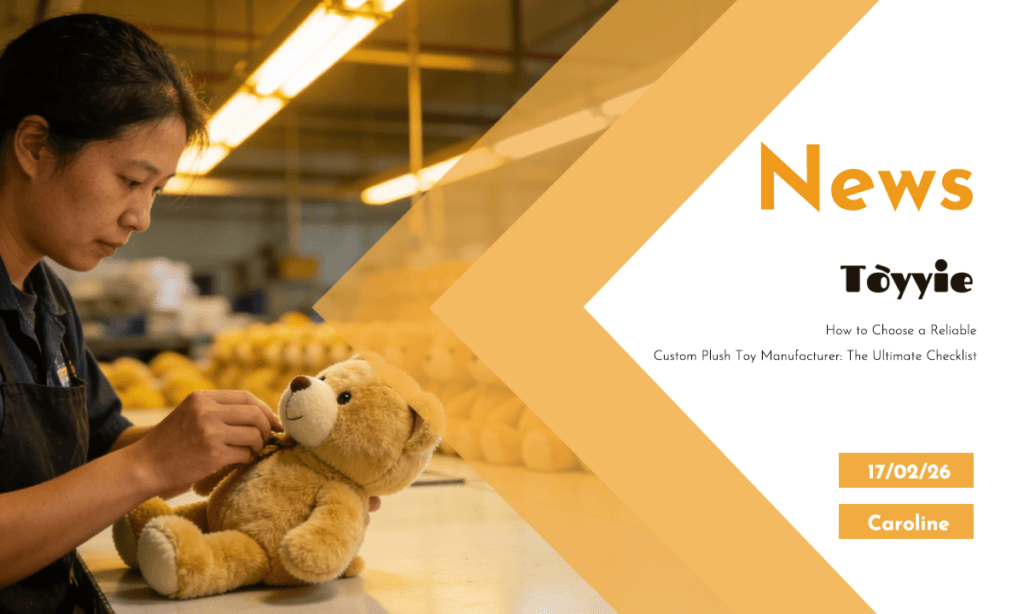
🧸 Essential Guide to Selecting a Custom Plush Toy Manufacturer: Ensure manufacturing reliability with a focus on quality control, transparent communication, and sample validation for optimal product development.
At TOYYIE, a leading OEM/ODM in custom plush toy manufacturing, we understand the critical importance of partnering with a manufacturer who delivers on both technical precision and creative vision. This guide outlines the key criteria to assess when selecting a plush toy manufacturer to guarantee superior craftsmanship and compliance.
🔍 Comprehensive Checklist for Evaluating Plush Toy Manufacturers
| Specification | Requirement | Industry Standard | TOYYIE Capability |
|---|---|---|---|
| Material Safety | Non-toxic, hypoallergenic plush fabrics | EN71, ASTM F963 | Certified compliant with EN71 parts 1-3 and ASTM F963 |
| Stitching Quality | Double-stitched seams with tensile strength ≥ 30N | ISO 13935-2 | All seams exceed 35N tensile strength |
| Eye & Nose Safety | Securely attached plastic components with safety locking | ASTM F963-17 | Enhanced locking mechanisms with pull force > 50N |
| Colorfastness | Color retention after 5 washes ≥ Grade 4 | ISO 105-C06 | Achieves Grade 4-5 colorfastness on all plush fabrics |
| Flammability | Meets low-flammability standards | 16 CFR Part 1500 | All materials tested under 16 CFR Part 1500 compliant protocols |
| Sample Turnaround Time | Prototype delivery within 15 working days | Industry Average | Standard sample delivery in 10-12 working days |
| Packaging Standards | Eco-friendly, protective packaging | ISO 14001 | Utilizes recyclable materials with ISO 14001 certification |
| Production Capacity | Minimum order quantity 500 units per SKU | OEM Industry Standard | Flexible MOQ starting at 300 units for custom projects |
Verification Beyond Digital Presence
A professional plush toy manufacturer must provide a comprehensive portfolio showcasing diverse plush toy designs, including complex embroidery and multi-material integration. Request detailed case studies and verified client testimonials that illustrate problem-solving capabilities and production transparency. Additionally, authentic behind-the-scenes documentation of manufacturing processes and quality control protocols is essential to assess operational standards.
TOYYIE Insight: TOYYIE adheres strictly to EN71 parts 1-3 and ASTM F963 standards, ensuring all plush toys pass rigorous mechanical and chemical safety tests, including flammability and heavy metal content, to deliver premium, child-safe products.
Optimizing Communication for Project Success
Effective communication is foundational in custom plush toy development. Evaluate the manufacturer’s responsiveness, specificity in addressing technical inquiries, and their willingness to engage in design for manufacturability (DFM) discussions. The presence of a dedicated project manager who liaises throughout the production cycle ensures streamlined coordination, reduces errors, and accelerates time to market.
The Critical Role of Sampling
Requesting a pre-production sample is indispensable for verifying material quality, stitch integrity, and compliance with safety standards such as EN71 and ASTM F963. Samples allow for tactile evaluation of plush softness, color accuracy, and assembly precision. They also provide a platform for iterative feedback, enabling manufacturers to accommodate adjustments prior to mass production, minimizing costly reworks.
Transparent Costing and Timelines
Manufacturers must provide a detailed quotation breakdown including mold fees, material costs, labor charges, packaging, and shipping. Clear articulation of lead times and contingency plans safeguards project timelines. Ambiguity in these areas often signals potential risks in production reliability and budget overruns.
TOYYIE Custom Plush Toy Manufacturing Capabilities
- Advanced Material Sourcing: Access to hypoallergenic, flame-retardant plush fabrics with superior colorfastness
- Precision Engineering: High-tensile double-stitched seams and secure plastic component integration
- Rapid Prototyping: Sample turnaround within 10-12 working days enabling agile product development
- Comprehensive Compliance: Full adherence to ISO 8124, EN71, ASTM F963 safety regulations
- Dedicated Project Management: Experienced managers ensuring end-to-end communication and quality control
- Flexible MOQ: Custom order quantities starting from 300 units tailored to client needs
Partner with TOYYIE for Premium Custom Plush Toys
Leverage TOYYIE’s expertise in OEM/ODM plush toy manufacturing to transform your creative concepts into compliant, high-quality products efficiently.
Contact TOYYIE Today →