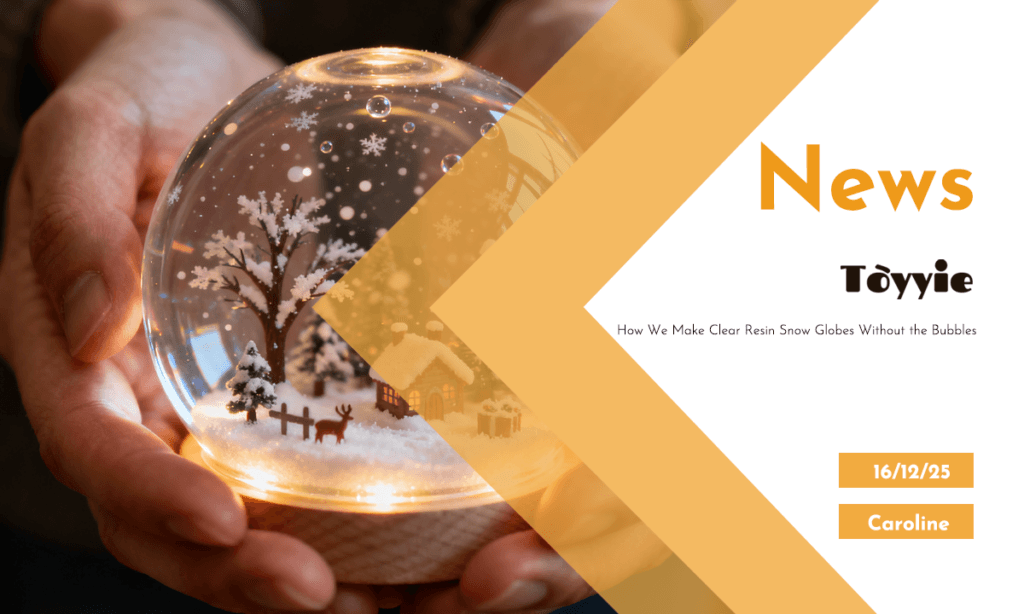
❄️ Precision Clear Resin Snow Globe Manufacturing: TOYYIE employs a vacuum stirring, low-pressure casting, and post-pour replenishment process to eliminate bubbles and haze, ensuring crystal-clear resin domes with superior optical clarity.
At TOYYIE, a leading OEM/ODM in premium toy manufacturing, we specialize in producing crystal-clear resin snow globes that meet the highest industrial standards. Our advanced process addresses common resin casting challenges such as bubbles and haze to deliver flawless, durable winter-themed collectibles.
Advanced Resin Casting Process ❄️
| Process Step | Technique | Purpose | Outcome |
|---|---|---|---|
| Vacuum Stirring | Mix resin and hardener under vacuum chamber | Remove entrapped air bubbles during mixing | Bubble-free, homogenous resin mix |
| Low-Pressure Casting | Pour resin into mold under reduced pressure | Prevent bubble entrapment and improve flow | Smooth, bubble-free dome surface |
| Post-Pour Replenishment | Light secondary pour after partial cure | Fill micro-sinks caused by resin shrinkage | Perfectly flat, glossy finish |
| Material Selection | Use silicone molds | Ensure easy demolding and surface integrity | No scratches or cracks on resin domes |
| Environmental Controls | Maintain temperature and humidity | Avoid moisture-induced haze and curing defects | Clear, haze-free resin castings |
| Additive Integration | Degas glitter and dyes separately | Prevent contamination of main resin clarity | Controlled decorative effects without cloudiness |
| Quality Testing | Mold leak and alignment verification | Guarantee dimensional accuracy and leak-proof assembly | Consistent production quality |
Vacuum Stirring: Eliminating Entrapped Air
TOYYIE utilizes precise vacuum stirring to mix resin and hardener components, significantly reducing microscopic air bubbles. By lowering the chamber pressure, entrapped air expands and is released before pouring. This method outperforms conventional mechanical stirring by enhancing resin clarity and structural integrity.
TOYYIE Insight: Vacuum stirring reduces resin bubble content by over 95%, critical to meeting ISO 9001 quality standards and EN71 safety compliance for collectible toys.
Low-Pressure Casting: Controlled Resin Flow
The resin is poured into silicone molds inside a low-pressure chamber, which lowers air pressure slightly to facilitate smooth resin flow and minimize new bubble formation. This technique ensures resin penetrates intricate mold details without trapping air, critical for achieving flawless dome curvature and edges.
TOYYIE Insight: Low-pressure casting minimizes trapped bubbles, ensuring ASTM D256 impact resistance is maintained by preserving resin structural integrity.
Post-Pour Replenishment: Addressing Resin Shrinkage
Due to inherent resin shrinkage during curing, TOYYIE implements a secondary light pour when the initial layer is tacky. This replenishment step fills micro voids and sink marks, eliminating the need for extensive sanding or polishing and guaranteeing a smooth, glossy surface finish.
Material and Environmental Controls for Optimal Results
Employing flexible silicone molds prevents damage during demolding, reducing defects such as scratches or cracks. Additionally, maintaining controlled temperature and humidity during mixing and casting prevents moisture-induced haze, especially important in colder seasons.
Decorative Additives Integration
To preserve optical clarity, glitter and dyes are mixed and degassed separately before precise injection into the resin scene. This targeted approach allows for vibrant visual effects without compromising the dome’s crystal transparency.
TOYYIE Manufacturing Capabilities
- OEM/ODM Expertise: Custom resin toy development with precision bubble-free casting
- Advanced Equipment: Vacuum chambers and low-pressure casting systems for superior quality
- Material Proficiency: Use of high-grade silicone molds and UV-resistant resins
- Quality Compliance: Adherence to ISO 9001, EN71, and ASTM safety standards
- Decorative Integration: Controlled additive and LED embedding for enhanced aesthetics
Partner with TOYYIE for Premium Resin Toys
Leverage our technical expertise and advanced resin casting process to produce flawless, collectible-grade snow globes and resin sculptures.
Contact TOYYIE →