📌 Introduction📌
If you’ve ever owned a high-end vinyl figure or designer plush, you know what sets the best apart isn’t just the design — it’s the **finish**.
A clean paint job. Sharp lines. No drips. No dust specks. No inconsistencies.
But achieving that kind of quality at scale? It’s not easy.
That’s why more and more top-tier toy factories — including those working with global brands like POP MART and Funko — are turning to **automated painting and inspection systems**.
Some people jokingly call these setups the **“Tesla factory” of collectibles** — sleek, precise, and almost entirely run by machines.
As someone running a small but innovation-focused toy factory in China, I’ve had the chance to work closely with both fully automated and semi-manual production lines.
In this article, I’ll walk you through:
Why **automation is becoming essential** for high-quality collectibles
How **robotic arms and AI vision systems** ensure zero-defect quality
What I’ve learned from visiting real-world smart toy factories
And practical advice for indie brands looking to improve their production standards
Let’s dive in.
From Hand-Painted to Machine-Perfect: The Evolution of Toy Finishing
Back when I first started in this industry, most small studios (including mine) still painted figures by hand.
It gave us creative control, yes — but also inconsistency.
One batch looked great. The next? Slightly off colors. A few missed spots. Tiny brush strokes.
For mass-market toys, that might be acceptable.
For premium or limited-edition collectibles? Not so much.
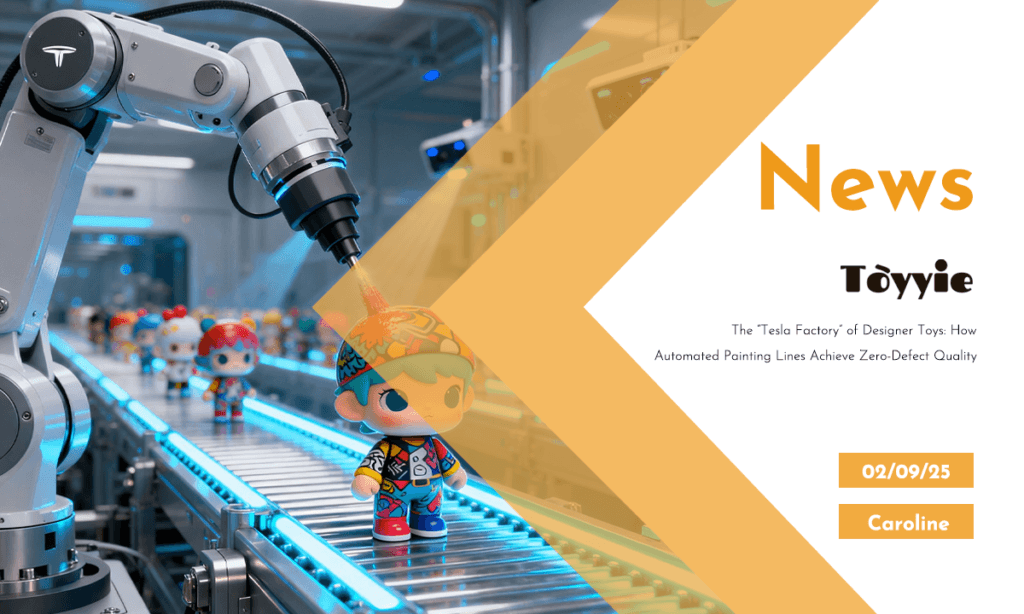
Today, many large-scale manufacturers use **fully automated spray booths** — where robotic arms apply primer, base coats, and final details with laser-level precision.
These systems aren’t just fast. They’re consistent.
And consistency equals quality — especially for collectors who expect perfection.
Behind the Scenes: How an Automated Paint Line Works
Here’s a simplified breakdown of how a modern, automated toy painting line works:
1. Pre-Treatment & Priming
Before any color goes on, each blank figure goes through an automatic degreasing and priming process. This ensures even surface adhesion and long-lasting durability.
2. Precision Spraying by Robotic Arms
Robots take over from here. Using pre-programmed paths and pressure settings, they apply multiple layers of paint — often with sub-millimeter accuracy.
This means no overlapping strokes, no human fatigue, and **no accidental smudges**.
3. Curing & Drying Chambers
Once painted, figures go into temperature-controlled ovens to cure. These chambers ensure the paint dries evenly and resists chipping.
4. AI-Powered Visual Inspection
This is where things get really cool.
After drying, each toy passes through a **vision inspection system** — basically a camera array powered by machine learning.
It checks for:
– Color accuracy
– Coverage gaps
– Surface blemishes
– Even microscopic dust particles
Any piece that doesn’t meet the standard gets automatically rejected.
No need for manual QC teams to squint under bright lights all day.
Real-World Example: Visiting a Smart Toy Factory in Dongguan
Last year, I got the chance to tour one of the largest smart toy factories in Dongguan — a place that supplies major global brands.
What struck me wasn’t just the technology — it was how **quiet** the whole operation was.
No painters shouting over spray guns. No cluttered tables filled with half-dried figures.
Just rows of robots, glowing LED lights, and conveyor belts moving silently.
At one station, I watched as a robot arm painted a complex MOLLY figure — every stripe, every highlight — exactly the same, every single time.
Later, the AI inspection system caught a tiny paint drip on one unit. Out it went — no debate, no second chances.
It was impressive. And honestly, a little humbling.
Because seeing that level of control made me realize how much room there is for improvement — even in our own shop.
Practical Tips for Indie Brands Looking to Improve Quality
You don’t need a full Tesla-style factory to start improving your toy finishing process.
Here are some steps I recommend based on my own experience:
✅ **Use digital color guides** — provide Pantone or RAL codes to ensure color accuracy across batches
✅ **Invest in better molds** — smoother mold lines mean less cleanup and fewer paint defects
✅ **Consider semi-automatic spraying** — if full automation is too expensive, look into tabletop auto-painters for base coats
✅ **Work with experienced coaters** — find partners who understand UV coatings, gloss levels, and scratch resistance
✅ **Include QC checkpoints** — whether manual or machine-based, make sure you inspect at least twice: after painting and before packaging
Even small changes can make a big difference — especially for collectors who expect near-perfect finishes.
Final Thoughts: Automation Isn’t Just for Big Brands Anymore
There was a time when only huge companies could afford advanced automation.
Now? Smaller shops like mine can access affordable versions of these tools — or partner with shared smart factories that offer pay-per-use services.
Automation doesn’t replace craftsmanship. But it does help preserve it — by eliminating avoidable mistakes and letting artists focus on what they do best.
Because at the end of the day, a collectible toy isn’t just a product.
It’s a piece of art. And art deserves to be finished perfectly.
Have you worked with automated painting systems or considered using them for your own toy line? Or maybe you’re curious about how to improve your finish quality without breaking the bank? I’d love to hear your thoughts — drop a comment below or send me a message. Let’s grow together in this exciting era of smart, high-quality collectibles.
📌 **#SmartToys #AutomatedPainting #ToyManufacturing #QualityControl #DesignerToys #VinylFigures #AIInspection #FactoryTech #ToyProduction #FutureOfCollectibles