The shipping costs are rising, contact us for a real-time quote.

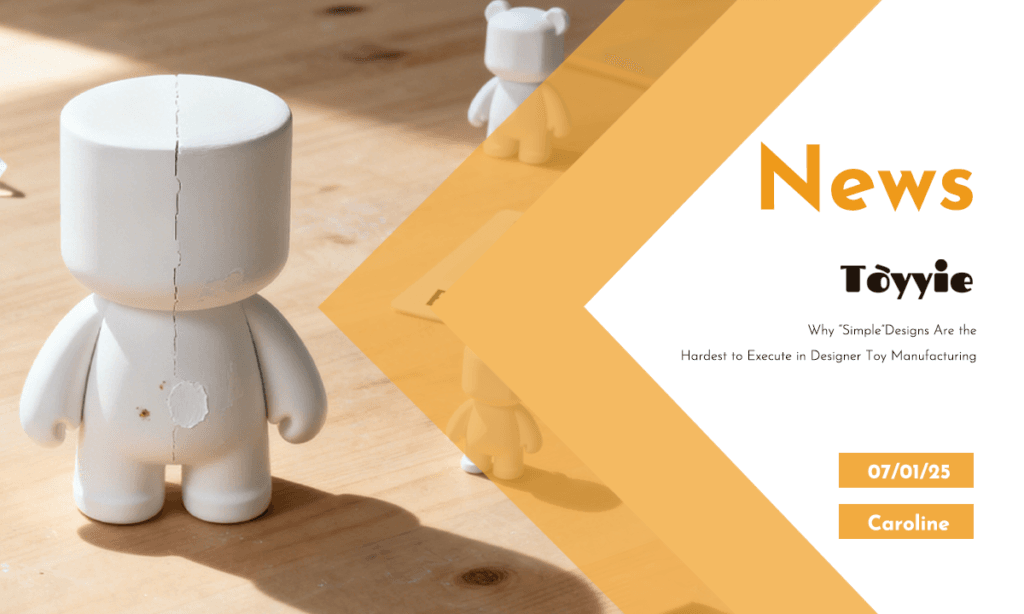
✨ Why “Simple” Designs Are the Hardest to Execute in Designer Toy Manufacturing 🧸

✨ Why “Simple” Designs Are the Hardest to Execute in Designer Toy Manufacturing 🧸 Technical Summary: The execution of minimalist designer toys requires precision tolerances within ±0.1mm, control of polymer shrinkage rates, and stringent surface finish standards to meet ASTM F963 and EN71-3 compliance. 📌 Introduction📌 When I first started working in the world of […]

Table of Contents

✨ Why “Simple” Designs Are the Hardest to Execute in Designer Toy Manufacturing 🧸

Technical Summary: The execution of minimalist designer toys requires precision tolerances within ±0.1mm, control of polymer shrinkage rates, and stringent surface finish standards to meet ASTM F963 and EN71-3 compliance.

📌 Introduction📌

When I first started working in the world of designer toy production, I was often caught off guard by a recurring irony: the designs that looked the simplest on paper often turned out to be the most challenging to bring to life. At first glance, a minimalist figure or a clean, geometric design might seem straightforward—“There’s nothing complicated here!”—but the reality is far more nuanced.

In this post, I want to take you through why this happens, sharing stories and insights from my experience. Whether you’re a seasoned toy designer or just dipping your toes into this industry, this guide will help you better understand the hidden complexities of seemingly simple designs. And, most importantly, I’ll share practical tips to help you navigate these challenges and ensure your creative vision comes to life exactly as you imagined.

🎨 The Illusion of Simplicity

What makes a design look “simple”? It’s usually clean lines, minimal details, or smooth surfaces. These features are visually appealing and universally loved, but they also leave little room for error. Every imperfection becomes glaringly obvious.

For example, I once worked with a designer on a sleek, cylindrical toy figure. It seemed straightforward—just one smooth, curved surface. However, during production, we discovered how difficult it was to achieve a perfectly smooth surface without visible seams or uneven paint. Small imperfections that might go unnoticed in a more detailed design were painfully obvious here.

Why this happens:

Lack of texture or details to hide flaws: In intricate designs, small imperfections can blend in with textures or busy patterns. Simple designs, on the other hand, put every little detail under a magnifying glass.

Precision becomes critical: When you’re working with clean, sharp edges or smooth curves, even a 0.1 mm deviation in the mold can ruin the look.

TOYYIE Engineering Insight: Minimalist toy designs require maintaining mold draft angles of at least 1.5° to facilitate demolding without surface damage. TOYYIE’s seven specialized factories optimize shrinkage rates typically around 1.5%-2% depending on ABS or PVC materials, ensuring surface uniformity and compliance with ASTM F963 and EN71-3 safety standards.

🔧 Manufacturing Tolerances: A Hidden Challenge

Manufacturing isn’t as precise as people often think. Every process—mold creation, injection molding, painting—has a tolerance range, meaning there’s always a small margin of error. With simple designs, these tolerances become much more noticeable.

Imagine you’re producing a toy with a perfectly round head. The mold might have a tolerance of ±0.2 mm, which sounds negligible. But when the product comes out slightly oval instead of perfectly round, the simplicity of the design makes the flaw impossible to ignore.

Key factors to consider:

Material shrinkage: Materials like plastic shrink as they cool, which can distort simple shapes.

Painting and coating layers: Even a slightly uneven coat of paint can throw off the clean look of a simple design.

TOYYIE Engineering Insight: Maintaining wall thicknesses between 2-4mm is critical to minimize warpage and achieve uniform cooling cycles averaging 30-45 seconds per shot in injection molding. TOYYIE’s shared equity in seven specialized factories enables fine control over shrinkage rates and undercuts to avoid surface defects and dimensional inaccuracies.

🎨 Color Matching Is Harder Than You Think

Simple designs often rely heavily on color to convey their aesthetic. A solid-color toy with no gradients, patterns, or decals might seem easy to produce, but achieving consistent, flawless color across batches is one of the hardest parts of manufacturing.

I remember a project where the toy was a single shade of bright yellow. It wasn’t until we saw the final batch that we noticed some pieces were slightly darker than others. The cause? A subtle inconsistency in the mixing of pigments.

Challenges with color in simple designs:

Consistency across batches: Even slight variations in color can ruin the clean aesthetic.

Material and paint interactions: Some materials absorb paint differently, which can lead to uneven finishes.

TOYYIE Engineering Insight: TOYYIE enforces color tolerance controls within ΔE ≤ 1.5 for Pantone matches, utilizing spectrophotometer data to assure batch-to-batch consistency. Our factories specialize in pigment dispersion techniques that optimize paint adhesion and reduce variability caused by absorption differences in ABS and PVC substrates.

🖌️ Smooth Surfaces Amplify Defects

Picture of Caroline
Caroline
Hi, I'm the author of this post, and I have been in this field for more than 5 years. If you want to wholesale toy or toy product, feel free to ask me any questions.
Picture of Caroline
Caroline
Hi, I'm the author of this post, and I have been in this field for more than 5 years. If you want to wholesale toy or toy product, feel free to ask me any questions.

Get A Free
Quote
And Estimate

Toyyie home Banner 2
NOW

Subscribe

SIGN UP FOR OUR WEEKLYNEWSLETTER

Be the first to hear about our new arrivals, upcoming deals,and exclusive promotions.

Keep me up to date on news and offers

For more information on how we process your data for marketingcommunication. Check our Privacy policy.