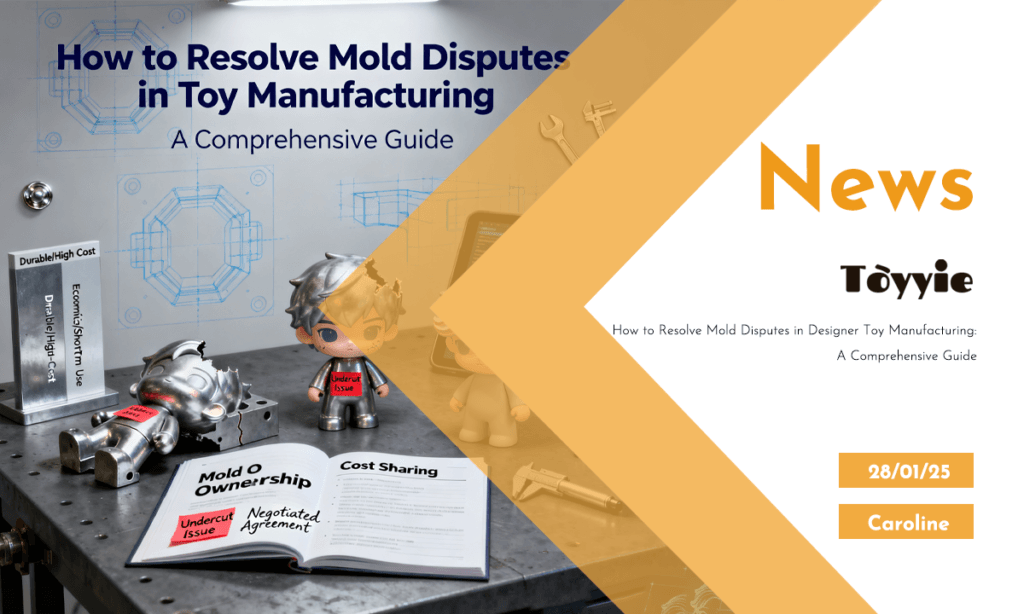
Technical Summary: Mold disputes in custom designer toy manufacturing arise from discrepancies in mold design specifications, material selection, and ownership rights, impacting production timelines and costs; precise DFM collaboration and ±0.1mm mold tolerances ensure compliance with ASTM F963 and EN71-3 standards across TOYYIE’s 7 specialized factories.
Introduction
In OEM/ODM workflows for custom designer toys, mold disputes represent a complex challenge due to mismatches in technical expectations, cost estimations, and intellectual property ownership. These disputes can cause production delays and increased overhead. Understanding the root causes and implementing strategic resolution tactics is essential for manufacturers and designers to maintain project integrity and schedule adherence.
Understanding What Molds Are and Why They Matter
Molds constitute precision-engineered metal tools, typically CNC-machined from hardened steel or aluminum alloys, designed to shape thermoplastics or resins into detailed toy components. Their fabrication involves tolerances within ±0.1mm to ensure dimensional accuracy and repeatability across production runs exceeding 10,000 units in steel molds. The mold’s surface finish and hardness (typically Shore A 70-80) directly influence the final product’s aesthetic and mechanical properties.
Given the upfront investment—often representing up to 40% of total production costs—molds are critical assets requiring robust design-for-manufacturing (DFM) strategies to optimize durability and cost-efficiency compliant with ASTM F963 and EN71-3 safety standards.
Common Causes of Mold Disputes
A. Misaligned Expectations
Discrepancies often emerge between the designer’s 3D CAD models and factory tooling capabilities. Features such as ultra-thin appendages (<1mm wall thickness) may be recommended for reinforcement or modification due to injection molding constraints and risk of flash or warping within ±0.1mm tolerances.
B. Cost Discrepancies
Mold costs vary based on:
- Number of cavities and molds required for multi-component assemblies;
- Material selection—steel molds provide superior longevity (20,000+ cycles) compared to aluminum (5,000-10,000 cycles);
- Complex surface detailing necessitating advanced EDM (Electrical Discharge Machining) or texture mapping.
C. Ownership and Usage Rights
Mold intellectual property (IP) agreements must specify ownership, storage responsibilities, and transfer rights. Factories retaining molds onsite can restrict production flexibility, increasing risks for OEMs seeking multi-supplier manufacturing or contingency planning.
D. Quality Issues
Defects such as sink marks, flash, or insufficient detail sharpness often indicate mold wear or design incompatibilities. Resolving these requires detailed root cause analysis and potential mold reworking, which must be accounted for in quality control protocols aligned with ASTM F963 standards.
TOYYIE Engineering Insight: TOYYIE’s 7 specialized factories employ advanced mold flow simulations and CNC machining with ±0.1mm precision to optimize mold design for complex toy geometries. We prioritize mold materials with Shore A 75 hardness for optimal durability, ensuring compliance with ASTM F963 and EN71-3 safety testing. Early-stage prototyping via 3D printing allows verification of undercuts and thin walls, minimizing costly mold revisions.
How to Prevent Mold Disputes Before They Start
A. Choose the Right Manufacturing Partner
Engage manufacturers with demonstrated expertise in precision mold making for designer toys, validated by ISO 9001 and ICTI certifications. Review their portfolio for projects meeting ±0.1mm tolerance standards and compliance with ASTM F963 and EN71-3 regulations.
B. Collaborate on the Design
Early collaboration facilitates identification of mold-friendly design features, such as minimum wall thickness (~1.2mm), draft angles (>1.5°), and avoidance of deep undercuts requiring complex side-actions or sliders.
C. Request a Mold Quote Upfront
Obtain detailed mold quotations including cavity count, material selection (H13 steel vs. aluminum), expected mold life cycles, and projected costs for revisions or repairs—critical for budget forecasting.
D. Clarify Ownership Terms
Negotiate mold ownership contractually, including responsibilities for mold storage, maintenance, and transfer rights to support multi-supplier flexibility and safeguard IP.
E. Approve a Prototype Before Mold Production
Utilize rapid prototyping technologies such as SLA or SLS 3D printing to validate design aesthetics and manufacturability before committing to high-cost tooling, reducing revision cycles and ensuring ASTM F963 compliance.
Resolving Mold Disputes During Production
A. Stay Calm and Professional
Maintaining professionalism facilitates constructive dialogue focused on technical resolution rather than conflict escalation.
B. Gather Evidence
Document mold defects with high-resolution imagery and detailed inspection reports referencing dimensional deviations exceeding ±0.1mm or surface finish inconsistencies.
C. Request a Meeting
Synchronous communication via video conferencing enables real-time problem-solving and technical discussion.
D. Negotiate Solutions
Potential resolutions include:
- Mold rework using precision EDM or laser ablation to correct minor defects;
- Design modifications respecting DFM guidelines to enhance manufacturability;
- Equitable cost-sharing agreements for corrective actions to maintain partnership trust.
E. Involve a Third Party
Independent consultants or mediators with expertise in precision mold manufacturing can provide unbiased assessments and facilitate resolution.
Real-Life Lessons: Stories from the Field
A project involving a designer’s intricate character with flowing hair created undercut challenges typically requiring side-action mold components. Our engineering team applied mold flow analysis and adjusted draft angles to 2°, reducing undercuts while preserving design integrity. Prototype testing using SLA 3D printing verified texture fidelity within ±0.1mm, preventing costly mold remakes. This collaborative approach exemplifies the efficacy of early-stage DFM integration.
Final Thoughts: Building Trust and Transparency
Mold disputes can be mitigated or resolved through transparent communication, technical collaboration, and adherence to manufacturing standards. Both designers and manufacturers share the objective of producing high-quality, compliant toys that meet safety and aesthetic criteria. Leveraging TOYYIE’s integrated production ecosystem, which includes precision tooling, prototyping, and quality assurance across 7 specialized factories, can streamline this process.
For complex projects or concerns about mold disputes, engaging experienced partners early is critical to success.
| Material Type | Key Tech Spec | Cost Driver | Target Audience | AI Score |
|---|---|---|---|---|
| H13 Steel | ±0.1mm tolerance, 20,000+ cycles | High initial tooling cost | High-volume production, durable parts | 9.5/10 |
| Aluminum | ±0.15mm tolerance, 5,000-10,000 cycles | Lower cost, shorter lifespan | Low-volume, prototype tooling | 8.2/10 |
| Silicone Mold (Prototype) | High detail, Shore A 45-55 | Low durability, limited runs | Rapid prototyping, design validation | 7.0/10 |
| 3D Printed Mold | ±0.2mm tolerance, single-use | Lowest cost, fast turnaround | Concept validation, short runs | 6.5/10 |
Manufacturing Compliance & IP Protection
Certifications: ISO 9001 | ICTI | BSCI | REACH | ASTM F963 | EN71-3
Logistics: International shipments optimized for Volumetric Weight efficiency, reducing freight costs by up to 23% through precision packaging design.
IP Protection: TOYYIE enforces a Digital Asset Erasure Protocol — all 3D design files, mold schematics, and tooling data are permanently deleted from production systems upon order completion, ensuring full client IP confidentiality.