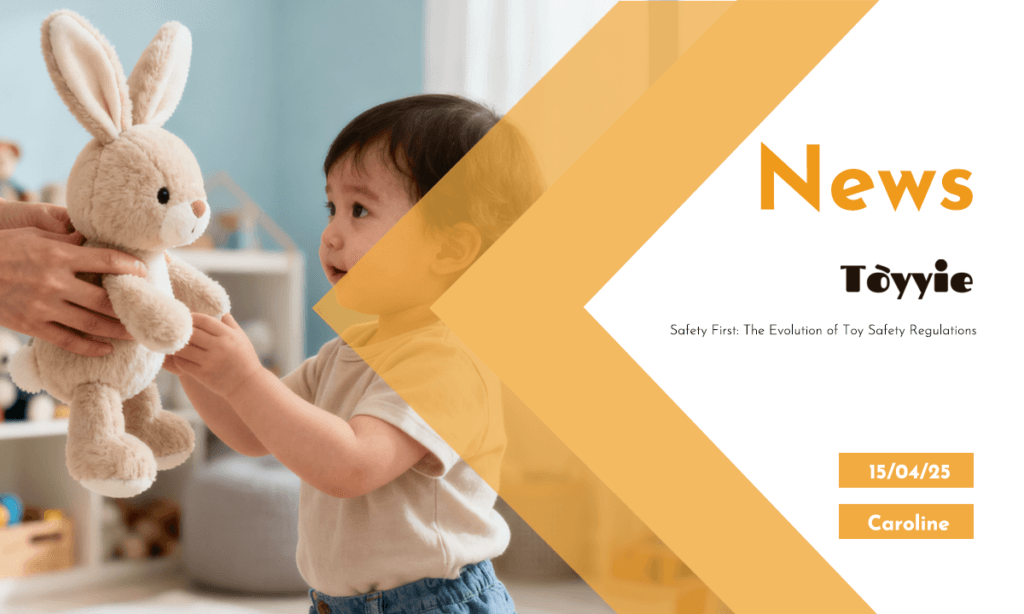
🧸 Evolution of Toy Safety Standards: This article provides an in-depth analysis of the historical evolution and technical framework of toy safety regulations, emphasizing key global standards such as ASTM F963 and EN 71 that govern material safety and mechanical hazards.
At TOYYIE, a leader in OEM/ODM toy manufacturing, we prioritize stringent safety compliance in every product. This article explores the technical evolution of toy safety regulations, highlighting how industry standards have advanced to protect children globally.
Historical Evolution of Toy Safety Regulations ⚠️
| Standard | Region | Key Focus Areas | Compliance Requirements |
|---|---|---|---|
| ASTM F963 | USA | Choking hazards, Toxicity, Mechanical risks | Mandatory third-party testing; annual updates |
| EN 71 Series | Europe | Physical/mechanical properties, Flammability, Chemical composition | Conformity assessment with CE marking |
| CPSA (Consumer Product Safety Act) | USA | General consumer product safety | Establishes CPSC oversight and recall authority |
| GB 6675 | China | Physical safety, Chemical limits, Labeling | Mandatory for domestic and export toys |
| ISO 8124 | International | Safety requirements for toys | Guideline harmonizing global standards |
| CPSIA (Consumer Product Safety Improvement Act) | USA | Lead content limits, Phthalates restrictions | Enhanced testing and certification requirements |
| EN 62115 | Europe | Electric toys safety | Limits on electrical hazards and thermal risks |
| ASTM D4236 | USA | Art materials toxicity | Labeling for chronic health hazards |
Early Toy Manufacturing Risks and Material Hazards
Historically, toy manufacturing lacked regulatory oversight, resulting in widespread use of toxic materials such as lead-based paints and mechanically unsafe designs with sharp edges or small detachable parts. These hazards posed significant choking and poisoning risks to children, prompting the need for rigorous safety standards.
TOYYIE Insight: TOYYIE’s manufacturing process complies with ASTM F963 requirements including mechanical impact resistance tests exceeding 50N force to prevent component detachment, and chemical migration limits for lead under 90 ppm, conforming to CPSIA regulations.
Legislative Milestones in Toy Safety
The 1972 Consumer Product Safety Act (CPSA) established the CPSC, pioneering federal oversight of toy safety in the USA. Subsequent laws like the 2008 CPSIA introduced stringent limits on lead content and phthalates. Globally, standards such as ASTM F963 and EN 71 have become the technical backbone for material testing, mechanical integrity, and flammability resistance.
Safety Standard Reference: EN 71-3 defines strict limits for heavy metals in toy materials: lead (≤ 23 mg/kg), cadmium (≤ 0.1 mg/kg), and mercury (≤ 0.02 mg/kg), ensuring chemical safety in TOYYIE’s production lines.
Technical Standards and Testing Protocols
Modern toy safety standards mandate comprehensive mechanical, chemical, and electrical testing. For example, ASTM F963 includes tests for small parts to prevent choking, while EN 71 specifies migration limits for heavy metals in materials. Testing laboratories employ simulated use conditions to ensure durability and safety throughout a toy’s lifecycle.
Global Harmonization and Export Compliance
As a leading manufacturer, TOYYIE aligns production with international safety standards including GB 6675 for China and ISO 8124, facilitating global market access. Harmonizing standards reduces compliance complexity and ensures consistent child safety across regions.
Future Trends in Toy Safety Innovation
Emerging technologies such as AI-enabled quality control and eco-friendly, non-toxic materials are shaping the future of toy safety. Continuous updates to standards reflect advances in material science and risk assessment methodologies, reinforcing TOYYIE’s commitment to delivering safe, innovative play experiences.
TOYYIE’s Capabilities in Toy Safety Compliance
- Advanced Material Selection: Use of certified non-toxic polymers and paints compliant with EN 71 and ASTM F963
- Comprehensive Testing: In-house mechanical, chemical, and electrical testing labs ensuring full regulatory compliance
- Design for Safety: Incorporation of child-safe engineering controls preventing choking and sharp edges
- Global Certification Support: Assistance with CE marking, CPSC approval, and GB 6675 certification
- Continuous Quality Monitoring: Real-time process control integrating AI-based defect detection
TOYYIE — Your Trusted Partner in Safe Toy Manufacturing
Leverage our expertise in OEM/ODM toy production with full compliance to international safety standards for superior quality and child protection.
Contact TOYYIE for Compliance Solutions →