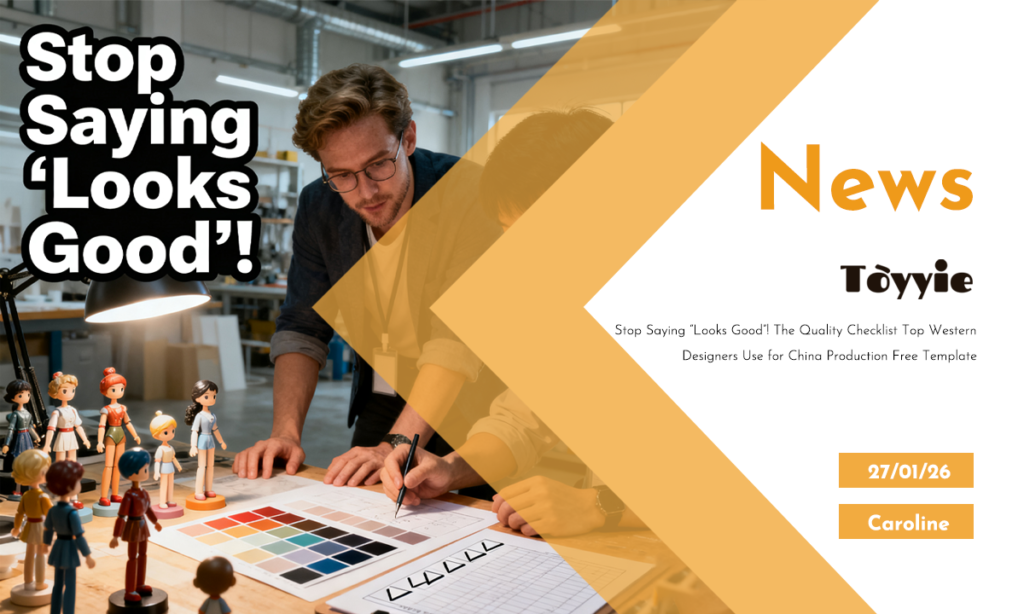
Stop Saying “Looks Good” During Toy Sample Review
You receive the first sample from your manufacturer. The shape looks close. The paint seems acceptable. The packaging looks fine in the photos. So you reply with the easiest phrase in product development: “Looks good.”
But what does that actually mean? Is the paint even? Are the eyes aligned? Is the base flat? Does the figure wobble on a shelf? Are the accessories secure? Does the box still look retail-ready after opening and closing?
In remote China toy manufacturing, vague feedback is expensive. When a designer, brand owner, or product manager is thousands of miles away from the factory, the factory team cannot guess which details matter most. They need a shared standard.
That standard should be a clear, visual, step-by-step quality control checklist. It turns “I will know it when I see it” into “please check this item, photograph it, and confirm pass or fail.”
Why “Looks Good” Fails in Remote Production
A factory may be excellent at production and still misunderstand your quality expectations. One brand may accept a small seam line on the underside of a figure. Another may consider it unacceptable because the product is sold as a premium collectible. One designer may allow slight color variation between handmade units. Another may need strict color consistency across every piece.
If those standards are not written down, the factory has to make assumptions. Those assumptions can affect paint, assembly, packaging, labeling, and even compliance preparation.
A good inspection checklist does not slow production. It prevents unclear approval, late-stage arguments, and avoidable rework. It also helps both sides protect the approved sample from being gradually changed during production.
The 5-Part Toy Quality Control Checklist
For custom figures, resin collectibles, vinyl toys, plush toys, and mixed-material character products, the checklist should cover both visual quality and functional reliability. The following five areas should be reviewed from sample approval to final shipment.
1. Surface and Finish
Surface quality is usually the first thing a buyer notices. It also reveals whether molding, polishing, painting, and handling were controlled properly.
- Mold lines and flash: Check visible edges, hands, face, hair, accessories, and underside areas.
- Air bubbles and pinholes: Pay extra attention to faces, hands, thin parts, translucent resin, and high-visibility surfaces.
- Paint smoothness: Look for streaks, overspray, dust, fingerprints, orange peel texture, and uneven coating.
- Approved finish match: Confirm that matte, satin, glossy, metallic, or soft-touch areas match the approved sample.
- Handling damage: Check scratches, rub marks, and packaging pressure points before shipment.
TOYYIE tip: Review the same sample under natural daylight and indoor LED lighting. Color, coating texture, and surface defects can look different under different light.
2. Color Accuracy
Digital colors are not reliable enough for final approval. A render, phone photo, or monitor image can make a red look warmer, a blue look brighter, or a translucent material look cleaner than it will appear in real life.
- Compare against physical swatches: Use approved paint chips, fabric samples, or material samples instead of screen references only.
- Check multiple units: Resin batches, fabric lots, and paint application can vary across production.
- Review all parts: Confirm color consistency across the head, body, accessories, base, and packaging components.
- Photograph side by side: Ask the factory to place the sample next to the approved swatch and shoot under controlled lighting.
For premium collectibles, a small color shift can change the character’s emotion. That is why color review should be treated as a production requirement, not a casual preference.
3. Alignment and Symmetry
Many quality problems are small but instantly visible once the buyer notices them. Misaligned eyes, tilted logos, uneven ears, crooked decals, loose joints, and blocked face details can make a custom toy feel rushed.
- Face alignment: Check eyes, mouth, eyebrows, blush, decals, and printed details.
- Body symmetry: Review ears, arms, legs, wings, tails, horns, and accessories from front, side, and back.
- Assembly gaps: Confirm that joints, seams, magnets, plugs, and snap-fit parts sit correctly.
- Logo and label placement: Make sure printed marks are centered, straight, and readable.
TOYYIE tip: Place two units side by side or back to back. Tilt, asymmetry, and assembly variation become easier to see when products are compared directly.
4. Function and Stability
A figure can look perfect in a photo and still fail in the customer’s hand. It may wobble, tip forward, lose an accessory, scratch during movement, or fail to hold a pose.
- Standing test: Place the figure on a flat surface and confirm there is no wobble or tipping risk.
- Joint movement: For articulated toys, joints should move smoothly and hold position without looseness.
- Accessory fit: Accessories should attach securely without damaging paint or requiring excessive force.
- Packaging movement: Shake or move the packed sample gently to confirm internal protection is sufficient.
A stability issue is not just a defect. For collectible toys, it can affect display value, photography, reviews, and repeat purchases.
5. Packaging, Labeling, and Presentation
Packaging is part of the product experience. A clean box, secure insert, correct label, and complete accessory layout can make a toy feel retail-ready. A dented box or unclear label can make even a good figure feel unreliable.
- Box condition: Check for dents, stains, crushed corners, color variation, and print errors.
- Insert fit: Confirm that the tray, foam, blister, or paper insert holds the figure and accessories securely.
- Accessory count: Verify every accessory, certificate card, sticker, instruction sheet, and replacement part if applicable.
- Label accuracy: Review barcode, logo, age label, warning label, material note, batch code, and shipping mark.
If the product is designed or intended primarily for children, packaging and labeling should also be reviewed against the target market’s safety requirements. For the U.S. market, CPSC guidance explains that children’s toys may need applicable ASTM F963 review, third-party testing, certification, and tracking information depending on age grading and product type.
Quality Checklist Decision Matrix
| Inspection Area | What to Check | Proof to Request | Approval Risk |
|---|---|---|---|
| Surface Finish | Mold lines, bubbles, scratches, paint smoothness | Close-up photos under natural and LED light | Visible defects become customer complaints |
| Color Accuracy | Color match across parts and batches | Photo beside approved physical swatch | Brand color or character mood may shift |
| Alignment | Eyes, decals, logos, accessories, assembly gaps | Front, side, back, and comparison photos | Figure can look off-character or low-end |
| Function | Standing stability, joint movement, accessory fit | Short test video and flat-surface photos | Display and use experience may fail |
| Packaging | Box, insert, labels, accessories, protection | Open-box photos and packed-product photos | Retail presentation and shipping protection suffer |
How to Use the Checklist Without Slowing Production
A checklist should make production faster, not heavier. The goal is to place inspection at the right checkpoints so issues are found before they multiply.
- First sample: Use the checklist to decide whether the sample is approved, rejected, or approved with changes.
- Pre-production sample: Confirm that material, color, finish, assembly, packaging, and labels match the approved standard.
- First production units: Inspect early units before the full batch continues.
- Final random inspection: Check a selected batch before shipment to catch packaging, finish, and assembly issues.
For larger orders, brands may also use formal sampling methods such as AQL inspection. For smaller custom toy runs, a practical checklist can still create discipline by defining what must be photographed, measured, compared, and approved.
What to Ask Your Factory to Send
Photos alone are not enough if they are random. Ask the factory to send evidence that matches each checkpoint. This makes review faster and reduces emotional arguments about whether a problem is “serious.”
- Close-up defect photos: Face, hands, hair, seams, decals, and high-visibility areas.
- Lighting comparison: Same unit under natural light and indoor light.
- Flat-surface test: Front and side photos showing whether the figure stands correctly.
- Short function video: Joint movement, accessory fit, magnet hold, or packaging shake test if relevant.
- Packaging proof: Box exterior, insert layout, accessory count, barcode, warning labels, and shipping carton marks.
Every photo should answer a question. If a photo does not help you approve or reject a checkpoint, it is probably not the photo you need.
Request the Free TOYYIE Quality Checklist Template
TOYYIE can provide a practical sample review and production inspection checklist for custom toy projects. It is designed for overseas designers who need to review samples remotely and communicate clearly with a China-based production team.
The template includes visual checkboxes, notes for sample photos, version control, approval status, and signature fields. You can use it for resin figures, collectible toys, plush characters, vinyl toys, and mixed-material products.
Request the Free QC Checklist Template
How TOYYIE Helps Brands Control Custom Toy Quality
At TOYYIE, we help designers and brand owners turn quality expectations into production checkpoints. We do not rely on vague approval language. We use samples, photos, checklists, and review stages to keep custom toy projects aligned from concept to shipment.
- Sample Review Support: We help compare prototypes against design files, physical swatches, and approved references.
- Finish and Color Control: We check paint, coating, color accuracy, texture, and special-effect materials before production expands.
- Assembly and Stability Checks: We review balance, joints, accessory fit, display angle, and packaging protection.
- Packaging and Label Review: We check box condition, inserts, accessory placement, barcode readability, warning labels, and batch information.
- Production Traceability: We help brands organize sample versions, batch records, and approval references for clearer project control.
- IP Protection: We manage files, molds, samples, and production references with controlled access to protect original character designs.
Clarity protects both sides. It helps the factory understand what matters, and it helps the brand approve products with confidence.
Need a Clear QC Standard for Your Toy Project?
Send TOYYIE your design files, sample photos, or production requirements. We can help you build a practical inspection checklist before small-batch or mass production begins.