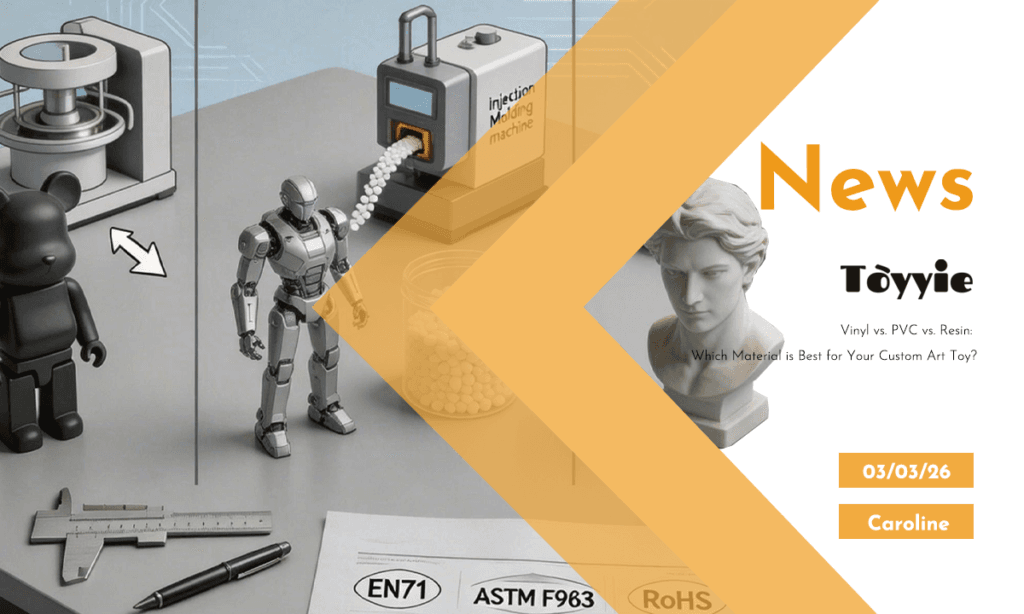
🧸 Material Analysis for Custom Art Toys: An in-depth comparison of Vinyl, PVC, and Resin materials focusing on their mechanical properties, manufacturing processes, and optimal applications in custom art toy production.
Selecting the appropriate raw material is a critical step in custom art toy manufacturing. At TOYYIE, leveraging over a decade of expertise, we provide comprehensive guidance on the technical merits of Vinyl, PVC, and Resin to optimize product performance and aesthetic appeal.
Material Selection for Custom Art Toys 🧩
| Material | Manufacturing Process | Typical Production Volume | Mechanical Properties (Hardness, Density) | Cost Considerations |
|---|---|---|---|---|
| Vinyl (Soft Vinyl / Sofubi) | Rotational molding / Vacuum forming | Small to medium runs (100-5000 pcs) | Shore A 60-80, Density ~1.2 g/cm³ | Higher tooling costs, moderate per-unit cost |
| PVC (Polyvinyl Chloride) | Injection molding | High volume (>5000 pcs) | Shore A 80-90, Density ~1.38 g/cm³ | Lower per-unit cost for large batches, high initial mold investment |
| Resin (Polyurethane / Epoxy) | Silicone mold casting | Low volume (50-500 pcs) | Shore D 70-90, Density ~1.1-1.3 g/cm³ | Low tooling cost, high per-unit cost |
| Material Compliance | Standards | Toxicity & Safety | Durability | Surface Detail Capability |
| Vinyl | EN71, ASTM F963 | Non-toxic with additives | Good impact resistance | Moderate fine detail reproduction |
| PVC | EN71, ASTM F963, RoHS | Non-toxic grades available | High durability | Excellent for intricate details |
| Resin | ASTM F963 (with post curing) | Depends on resin type | Brittle, fragile on impact | Superior surface texture fidelity |
Vinyl: Soft Vinyl Manufacturing and Applications
Vinyl toys are produced primarily through rotational or vacuum molding techniques, yielding hollow, lightweight figures with a distinct soft-touch finish. This material excels in medium-volume production runs and offers excellent impact resistance, making it ideal for designer urban vinyl collectibles. However, tooling costs are relatively high, and the material’s elasticity limits precision when reproducing ultra-fine surface details.
TOYYIE Insight: TOYYIE’s injection molding process for PVC achieves tolerances within ±0.1mm, enabling precise replication of intricate details compliant with ASTM F963 standards.
PVC: Injection Molding for High-Detail Mass Production
PVC is favored for injection molding due to its thermoplastic nature, enabling high-precision detail capture and solid, durable figures. It is the industry standard for large-scale action figures and anime collectibles. Despite a heavier weight compared to vinyl, PVC’s mechanical robustness and lower per-unit cost in bulk runs make it optimal for high-volume production. Professional-grade molds are essential to achieve consistent quality.
TOYYIE Insight: Using rotational molding, TOYYIE produces hollow vinyl toys with wall thickness controlled between 1.5-2.5 mm to balance weight reduction and mechanical strength, aligning with EN71 durability requirements.
Resin Casting: Premium, Low-Volume Prototyping and Collectibles
Resin materials, including polyurethane and epoxy variants, are cast using silicone molds, which have minimal upfront tooling costs. Ideal for prototypes and limited-edition statues, resin delivers the highest fidelity in surface texture and sharp detail reproduction. However, resin parts are inherently brittle, requiring careful handling and packaging. The higher unit cost is justified by the premium finish and limited quantities.
Design for Manufacturing (DFM) Considerations
When selecting between vinyl, PVC, and resin, DFM principles must guide material choice. Vinyl requires design allowances for shrinkage and draft angles due to its molding process. PVC demands precise mold design to accommodate complex geometries and thin walls, while resin casting favors simpler designs due to brittleness and curing constraints. Understanding these parameters ensures optimal manufacturability and cost-efficiency.
Safety and Compliance in Toy Manufacturing
TOYYIE ensures all materials and processes comply with stringent international standards including EN71 (European Toy Safety Directive), ASTM F963 (US Toy Safety Standard), and RoHS for chemical safety. This guarantees non-toxic, durable, and child-safe products across all material types, meeting global regulatory requirements.
TOYYIE’s Expertise Across Materials
- Vinyl Expertise: Custom rotational molding with advanced soft vinyl formulations
- PVC Injection Molding: High-precision mold making and mass production capabilities
- Resin Casting: Silicone mold fabrication for prototype and limited edition collectible runs
- Quality Assurance: ISO 9001 certified processes with compliance to EN71 and ASTM F963
- Design Support: Comprehensive DFM consulting to optimize manufacturability and cost
TOYYIE — Your Partner for Superior Custom Art Toys
With over 12 years’ experience and Disney-certified quality assurance, TOYYIE delivers premium manufacturing solutions in vinyl, PVC, and resin tailored to your project’s needs.
Request a Free Quote →