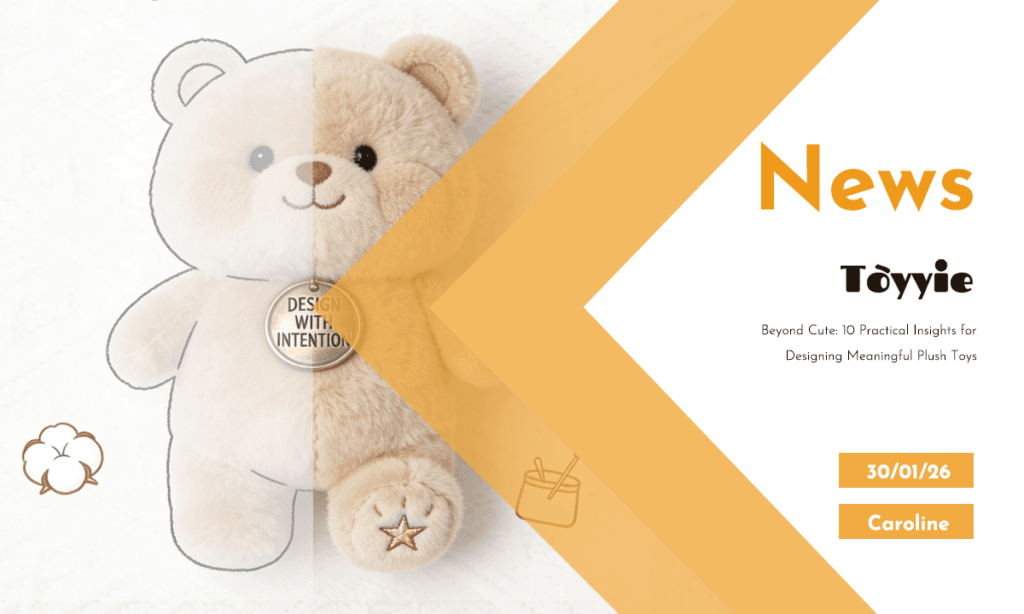
Beyond Cute: What Makes a Plush Toy Meaningful?
A plush toy may look simple, but a meaningful plush product carries far more than a cute face. For a child, it may become a bedtime companion. For a parent, it must feel safe and washable. For a collector, it must express the personality of a character. For a brand, it must communicate care in every stitch.
This is why plush toy design should not begin with decoration alone. It should begin with the question: what role will this toy play in the user’s life? A pocket-size mascot, a sleep companion, a sensory comfort toy, a display plush, and a premium character collectible all need different materials, proportions, stuffing, labels, and quality controls.
At TOYYIE, we treat plush development as a balance between emotion and engineering. The goal is to create a soft toy that looks lovable, feels right in the hand, survives real use, and can be manufactured consistently.
1. Choose Materials That Build Trust
Parents often touch a plush toy before they read the label. The first signal of quality is usually fabric feel: softness, pile length, density, odor, and whether the surface feels clean against the skin.
For young children, short-pile polyester, cotton fabrics, and carefully selected plush textiles are often easier to manage than long-pile fabrics that may trap dust or shed fibers. If a brand wants to communicate higher textile safety, certifications such as OEKO-TEX® STANDARD 100 can be useful because testing is based on intended use and includes stricter requirements for baby and toddler product classes.
Material Checks to Request
- Fabric hand feel: Compare short pile, minky, velboa, cotton, velvet, fleece, and specialty textured fabrics.
- Stuffing recovery: Check whether the filling returns to shape after compression and washing.
- Odor and dye quality: Reject fabrics or prints with strong chemical odor, unstable color, or visible transfer.
- Skin-contact suitability: Choose softer, cleaner, and lower-shedding materials for babies and toddlers.
The best plush material is not always the softest option. It is the material that matches the age group, product purpose, cleaning method, cost target, and safety requirements.
2. Let Size Serve the Use Case
Plush size determines where the toy will live. A tiny mascot may hang from a backpack. A medium plush may sleep beside a child. A large display plush may sit on a shelf, sofa, or retail window. Each size has different risks.
- Pocket plush: Attachment loops, keyrings, and small accessories need reinforcement and age-appropriate review.
- Bedtime plush: The body should be soft enough to hug, but seams must hold up to repeated compression.
- Display plush: Larger plush toys may need better internal structure, base stability, and packaging support.
Size also affects safety. Small parts, detachable accessories, long cords, magnets, and hard components must be reviewed carefully, especially for toys intended for children under 3 years old or products marketed to children 12 and under in the United States.
3. Design the Face for Emotional Clarity
A plush toy’s face is often the emotional center of the product. Small changes in eye placement, mouth curve, embroidery thickness, and cheek shape can change the entire personality of the character.
For children’s plush toys, simple expressions often work better than overly complex embroidery. A gentle curve, balanced eyes, and soft cheek areas can communicate warmth quickly. For brand mascots and collectibles, more detail may be appropriate, but the expression still needs to survive fabric distortion, stitching limits, and production variation.
Face Design Checks
- Embroidery readability: Check whether the expression is still clear from a normal viewing distance.
- Symmetry: Confirm that eyes, cheeks, nose, mouth, and eyebrows are aligned after stuffing.
- Safety choice: For young children, embroidered eyes are often safer than detachable plastic eyes.
- Emotion match: The expression should match the brand story: calm, brave, sleepy, playful, protective, or curious.
A plush face should not only look cute in a flat drawing. It should still feel alive after sewing, turning, stuffing, and final shaping.
4. Use Tactile Details With Purpose
Young children explore with their hands. Adults also judge plush quality through touch. This makes tactile design one of the most powerful tools in plush development.
One textured detail can make a plush toy more memorable: ribbed ears, velvet paw pads, a smooth cheek zone, a crinkle panel, a small embroidered star, or a soft belly area. These details should feel intentional, not random.
- Comfort zones: Keep cheeks, belly, and hug areas smooth enough for repeated contact.
- Discovery details: Add one or two raised embroidery or fabric texture areas for tactile interest.
- Durability review: Make sure texture panels, tags, ribbons, and accents cannot loosen easily.
- Sensory balance: Avoid adding too many competing textures to a toy meant for calming use.
A meaningful plush toy does not need to be visually loud. Sometimes the strongest feature is a quiet texture that the owner discovers after holding it.
Plush Design Decision Matrix
| Design Area | What It Communicates | Production Risk | Best Practice |
|---|---|---|---|
| Fabric | Softness, safety, cleanliness, brand quality | Shedding, odor, color transfer, inconsistent pile | Approve physical fabric swatches before sampling |
| Stuffing | Hug feel, shape recovery, comfort | Lumps, collapse after washing, uneven firmness | Test compression, washing, and hand feel |
| Face | Emotion, character identity, trust | Misalignment after stuffing or embroidery shift | Review expression on finished stuffed samples |
| Accessories | Storytelling and collectible value | Detachment, choking risk, weak stitching | Use age-appropriate attachment and pull testing |
| Packaging | Gift readiness, sustainability, retail trust | Compression damage, unclear labels, excess waste | Match packaging to sales channel and compliance needs |
5. Build in Repairability and Care
A well-loved plush toy will be squeezed, slept on, washed, dropped, dragged, and carried everywhere. Brands that design for care and repair create a better long-term ownership experience.
- Care label clarity: Explain washing temperature, drying method, and whether machine washing is allowed.
- Repair-friendly seams: Consider hidden access points or construction that allows future restuffing when appropriate.
- Matching thread: Provide or specify thread color so simple repairs are less visible.
- Digital care guide: A simple care and repair guide can reduce customer questions and extend product life.
Repairability is not only practical. It also tells customers the product was made to be kept, not thrown away.
6. Treat Cultural Elements With Respect
Plush toys often use cultural symbols, clothing patterns, folklore creatures, festival colors, or regional motifs. These details can build emotional connection when they are researched and credited. They can damage trust when they are used as generic decoration.
- Research before sketching: Understand the meaning of symbols, colors, patterns, and costume elements.
- Work with advisors: When using specific cultural references, consult people who understand that tradition.
- Credit collaborators: Public acknowledgment can show respect and transparency.
- Avoid sacred misuse: Do not use sacred symbols or ritual objects as casual decoration.
Meaningful design depends on intention. If a cultural element is important to the character, document its meaning so the production team can protect it.
7. Make Sustainability Specific
Sustainability claims need precision. Buyers are more skeptical of vague phrases such as “eco-friendly” or “green.” A stronger approach is to explain exactly which parts of the plush product are improved and which parts are still being optimized.
- Recycled filling: Certified recycled PET filling can support a lower-impact material story when it meets performance needs.
- Responsible packaging: FSC-certified paper tags or packaging can help brands document responsible paper sourcing.
- Lower-waste packaging: Reduce unnecessary plastic, oversized boxes, and non-recyclable inserts where possible.
- Transparent claims: State what is certified, what is recycled, and what is not yet sustainable.
Honest sustainability is stronger than perfect-sounding sustainability. Clear material and packaging choices help customers understand what the brand actually did.
8. Test the Plush Like a Real User Would
Laboratory testing and compliance review are essential, but they do not replace real-use observation. A plush toy should be evaluated in the situations where it will actually live: bedtime, travel, unboxing, shelf display, gifting, washing, and daily handling.
- Parent review: Ask caregivers whether the plush feels safe, comforting, easy to clean, and appropriate for the target age.
- Child interaction: Observe where the child holds it, whether they hug it, and which details they touch first.
- Wash test: Check shape recovery, stitching, fabric hand feel, and color after washing.
- Unboxing review: Film the first opening to see whether the expression, softness, and presentation work immediately.
The best plush feedback often comes from quiet observation. If users naturally hold the toy close, the design is doing something right.
Safety, Compliance, and Age Grading
Plush toys intended for children must be reviewed against the safety rules of the target market. In the United States, children’s toys are subject to ASTM F963 as incorporated into CPSC rules, and toys designed or intended primarily for children 12 and under may require third-party testing and a Children’s Product Certificate. For the European Union, toys placed on the market must meet applicable safety requirements and bear CE marking.
For plush toys, common review areas include small parts, seam strength, stuffing access, loose accessories, cords, magnets, sound modules, flammability considerations, chemical requirements, tracking information, warning labels, and age grading. These should be discussed before sampling, not only before shipment.
How TOYYIE Helps Brands Develop Meaningful Plush Toys
TOYYIE helps brands move from plush concept to production-ready soft toy through material review, pattern development, sampling, safety planning, and quality control. Our goal is to preserve the emotional purpose of the design while making it realistic to manufacture.
- Material and Fabric Sourcing: We help compare plush fabrics, cotton textiles, minky, velboa, fleece, velvet, recycled filling, and specialty textures.
- Pattern and Prototype Development: We translate sketches or 3D references into plush patterns, sample shapes, and sewn prototypes.
- Embroidery and Face Review: We check expression, eye alignment, embroidery density, color, and personality after stuffing.
- Safety and Compliance Planning: We help brands review age grading, small parts, labels, warning requirements, and target-market testing needs.
- Wash and Durability Checks: We review seams, stuffing recovery, fabric behavior, accessory attachment, and packaging protection.
- IP Protection: We manage character files, samples, patterns, and production references with controlled access to protect original designs.
Great plush design is not about perfection. It is about clear intention woven into every decision: fabric, shape, stitch, stuffing, label, packaging, and the quiet detail that makes a user want to keep it close.
Designing a Plush Toy That Needs to Feel Meaningful?
Send TOYYIE your sketch, character story, target age group, and material goals. We can help you develop a plush toy that balances comfort, safety, manufacturing quality, and emotional value.