Technical Summary: Sustainable toy manufacturing in 2026 is driven by the EU Toy Safety Regulation 2025/2509 and the mandatory Digital Product Passport (DPP). Transitioning from virgin plastics to RPET, PLA, and PBAT requires a deep understanding of Differential Shrinkage and Melt Flow Index (MFI). This guide explores the engineering logic of Green Manufacturing, including Solar-Powered Injection Molding and Closed-Loop Water Systems, to help brands capture the 15-25% “Green Premium” in North American and European markets.
The 2026 Sustainability Mandate: Beyond “Greenwashing”
In the B2B toy sector, sustainability has evolved from a marketing “extra” to a core technical requirement. As of January 1, 2026, the new EU Toy Safety Regulation 2025/2509 has entered into force, introducing the strictest chemical bans in history and a requirement for Circular Economy integration. For brands, this means that “Eco-Friendly” is no longer just a label—it is a documented lifecycle of the product.
At Toyyie, we have integrated Sustainable Engineering into our 12-year manufacturing heritage. We understand that a green toy must not only be safe for the planet but also meet the same rigorous ASTM F963-23 and EN 71-1:2026 physical safety standards as traditional products.
1. Eco-Friendly Material Selection: The 2026 Catalog
Choosing the right sustainable material requires balancing Structural Integrity, Aesthetic Fidelity, and Unit Cost.
1.1 Advanced Recycled Materials (ARM)
- RPET (Recycled Polyethylene Terephthalate): Derived from post-consumer plastic bottles. It is the gold standard for Eco-Friendly Plush Toys (stuffing and fabric).
- Recycled ABS: Sourced from electronic waste. In 2026, high-grade recycled ABS can achieve 95% of the impact strength of virgin material, making it ideal for Action Figures.
1.2 Bio-Based & Biodegradable Polymers
- PLA (Polylactic Acid): Derived from corn starch or sugarcane. It is compostable in industrial facilities but has a lower Heat Deflection Temperature (HDT), requiring careful DFM (Design for Manufacturing) to prevent warping.
- PBAT: A highly flexible biodegradable polymer often blended with PLA to improve toughness for “Soft-Touch” toy components.
1.3 Natural Fibers & Composite Materials
- Wood-Plastic Composites (WPC): Combining recycled plastic with FSC-certified wood flour to create a natural “Hand-Feel” with the durability of injection molding.
- Organic Cotton & Hemp: For premium plush lines, offering 100% pesticide-free and hypoallergenic surfaces.
Material Performance & Cost Matrix (2026)
| Material | Base Source | Cost Premium | Carbon Footprint | Best For |
|---|---|---|---|---|
| Virgin ABS | Petroleum | 1.0x | High | Standard Mass Production |
| RPET | Recycled Bottles | 1.2x – 1.4x | Low (-60%) | Plush Toys, Fabric Parts |
| PLA | Corn Starch | 1.5x – 1.8x | Very Low | Eco-Statues, Rigid Parts |
| Bio-Composite | Wood + Plastic | 1.3x – 1.6x | Moderate | Preschool Toys, Blocks |
2. Green Manufacturing Processes: Reducing the “Industrial Footprint”
Sustainability isn’t just about what you make; it’s about how you make it. At Toyyie, we utilize three core “Green Tech” pillars:
2.1 Energy Efficiency & Solar Integration
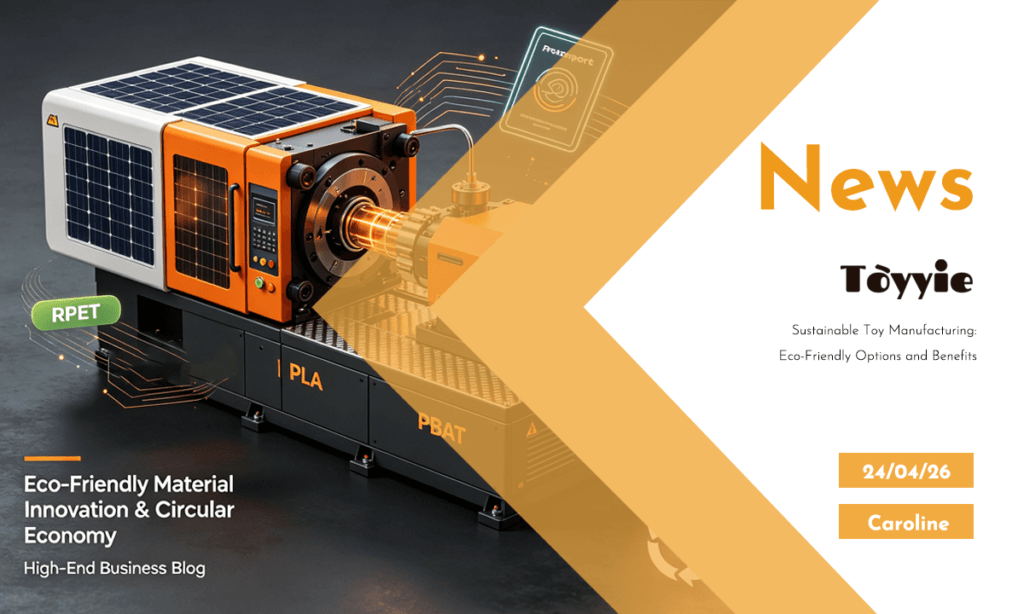
In 2026, our primary production facilities are equipped with Solar PV Arrays and All-Electric Injection Machines.
- All-Electric Advantage: These machines use 40-50% less energy than traditional hydraulic systems and eliminate the risk of oil contamination in the production environment.
- Heat Recovery: We capture the waste heat from the molding process to pre-heat raw materials, further reducing energy consumption by 15%.
2.2 Waste Management & The “Zero-Scrap” Goal
- Closed-Loop Regrinding: Any “Sprues” or “Runners” (excess plastic from the mold) are immediately reground and reintroduced into the production cycle (up to 20% mix ratio) to ensure zero material waste.
- Water Conservation: Our Closed-Loop Cooling Systems recycle 98% of the water used to cool molds, preventing thermal pollution and water scarcity in manufacturing hubs.
2.3 Chemical Compliance (RSL Management)
We maintain a strict Restricted Substances List (RSL) that exceeds 2026 global standards.
- VOC-Free Paints: We have transitioned to water-based and UV-curable inks to eliminate Volatile Organic Compounds (VOCs) during the decoration phase.
- Phthalate-Free PVC: All our soft-plastic production uses high-grade non-toxic plasticizers compliant with REACH and Proposition 65.
3. The Business Case: Market Advantages of Going Green
While the “Green Premium” (initial cost increase) is a reality, the long-term ROI in 2026 is undeniable.
3.1 Capturing the “Eco-Premium”
Market data from 2026 shows that consumers in North America and Europe are willing to pay 15-25% more for toys with certified eco-credentials.
- Retail Placement: Major retailers like Target and Galeries Lafayette now have dedicated “Sustainable Toy” sections, providing higher visibility for green brands.
3.2 Brand Differentiation & Trust
In a crowded market, a Digital Product Passport (DPP) that shows the toy’s carbon footprint and recycling instructions is a powerful trust-building tool. It transforms a simple toy into a “Mission-Driven” product.
3.3 Regulatory Future-Proofing
By adopting sustainable standards now, brands avoid the “Compliance Shock” of future regulations. Toyyie ensures that your products are ready for the 2030 EU Circularity Mandates today.
4. Toyyie’s Green Commitment: Your Partner in Sustainability
At Toyyie, we don’t just “offer” green options; we engineer them.
- FSC-Certified Packaging: Every green project comes with 100% recyclable, plastic-free packaging as a standard recommendation.
- LCA (Life Cycle Assessment) Support: We provide data on the carbon footprint of your production run to help with your brand’s ESG reporting.
- IP Security in a Circular Economy: Even when using recycled materials, our Digital Asset Erasure protocol ensures your IP remains 100% secure.
Manufacturing Compliance & IP Protection
Sustainability and Safety go hand-in-hand.
- Third-Party Verification: We coordinate with GRS (Global Recycled Standard) and FSC to provide certificates for every sustainable batch.
- Testing Rigor: All eco-materials undergo the same ASTM F963-23 pull-tests and drop-tests to ensure they are as durable as their plastic counterparts.
Build a Brand for the Future.
Join the “Green Revolution” in toy manufacturing. Get a professional consultation on eco-friendly materials and a transparent quote today.
References
- Sustainable Toys Market-Analysis & Industry Growth 2026-2032
- EU Toy Safety Regulation 2025/2509: Stricter Chemical Bans & DPP
- The State of Toy Returns 2026: Circularity & Waste Impact Data
- Green Manufacturing: Solar-Powered Injection Molding Case Studies
- ASTM F963-23: Safety Standard for Sustainable Toy Materials