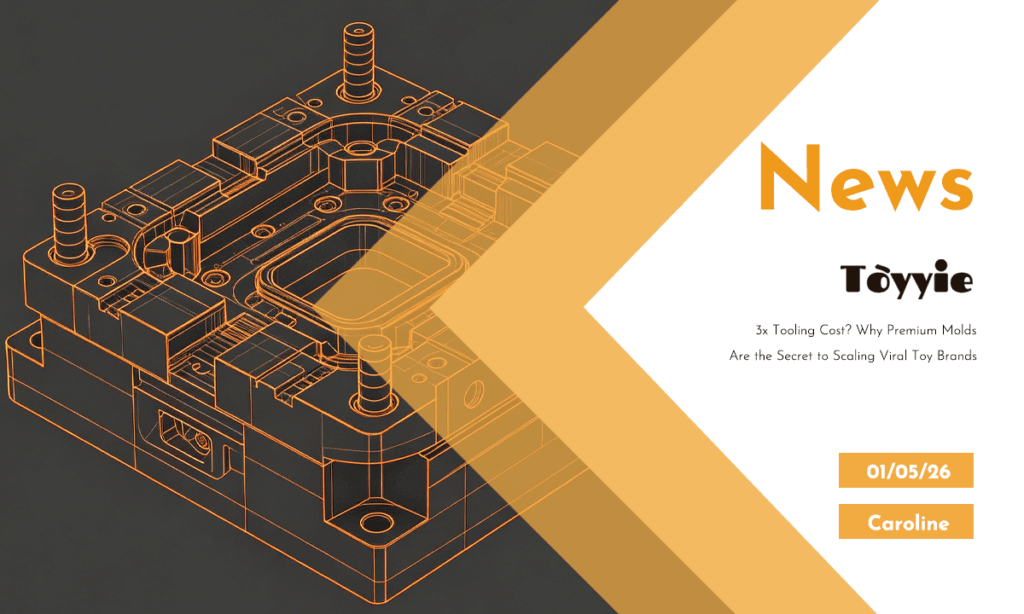
The Illusion of Cheap: Why Mold Costs Are More Than Just a Number
In the competitive world of custom toy manufacturing, the initial cost of a mold can be deceptive. A mold quoted at $5,000 might seem like a bargain compared to one at $15,000. However, in 2026, this “3x difference” often represents a fundamental divergence in Engineering Quality, Production Efficiency, and ultimately, your Brand’s Profitability.
At TOYYIE, with 12 years of experience, we’ve seen countless brands fall into the “cheap mold trap.” This guide will dissect the hidden costs and long-term benefits, proving that for a “Hit Product,” investing in a premium mold is not an expense, but a strategic asset.
Product Quality: The “Flash” That Kills Profitability
1. The Problem: Flash and Secondary Processing
- Cheap Molds (P20 Steel): Often made with lower-grade steel and less precise machining, these molds are prone to developing Flash (披锋)—excess material that squeezes out between mold halves during injection [1]. This is particularly common in complex toy geometries or when using softer plastics.
- Consequence: Every unit with flash requires Manual Secondary Processing (人工二次处理)—a labor-intensive, time-consuming, and costly operation. In 2026, manual labor in manufacturing can add $0.10 – $0.50 per unit to your cost, depending on complexity, quickly eroding your profit margins [2].
2. The Solution: Precision and “One-Step” Production
- Premium Molds (S136, H13 Steel): These molds are crafted from hardened, high-precision steel, often using 5-axis CNC machining to achieve ±0.01mm tolerances [3]. This ensures a perfect seal between mold halves, virtually eliminating flash.
- Benefit: Products come out of the mold “one-step” (一步到位), requiring minimal to no post-processing. This not only saves labor costs but also maintains the pristine quality and aesthetic appeal crucial for premium toy brands.
Production Efficiency: Automation vs. Manual Intervention
1. The Bottleneck: Manual Assistance
- Cheap Molds: Due to design limitations (e.g., poor draft angles, complex undercuts) or wear and tear, cheaper molds often require Manual Assistance during the injection molding cycle. Operators might need to physically remove parts, clean flash, or even assist in part ejection [4].
- Impact: This manual intervention significantly slows down the Cycle Time (成型周期). A process that could take 20 seconds automatically might stretch to 40-60 seconds with manual help, effectively halving your production output per hour.
2. The Advantage: Fully Automated Operation
- Premium Molds: Designed for Automated Operation, these molds incorporate features like Hot Runner Systems (eliminating sprues), Robotic Part Ejection, and Integrated Cooling Channels [5]. They are engineered for consistent, high-speed performance.
- Benefit: A premium mold can run 24/7 with minimal human oversight, achieving optimal cycle times and maximizing Machine Utilization Rate. This translates directly to a lower Unit Cost and faster time-to-market, especially vital for seasonal toy releases.
Mold Lifespan: The True Cost of “Explosive Growth”
1. The Limitation: Short Shot Life
- Cheap Molds (P20 Steel): Typically rated for a Shot Life (模次) of 50,000 to 100,000 cycles [6]. After this, the mold steel begins to wear, leading to increased flash, dimensional inaccuracies, and frequent maintenance.
- Risk for “Hit Products”: If your toy becomes a “爆款产品” (viral hit), a cheap mold simply “扛不住” (cannot withstand) the demand. You’ll face constant Maintenance Downtime (停机维修), costly repairs, or even the need to build a completely new mold, causing significant production delays and lost sales.
2. The Investment: Extended Durability
- Premium Molds (S136, H13 Steel): Constructed from high-hardness, wear-resistant steel, these molds are designed for 300,000 to 500,000+ cycles, with some reaching millions of shots [7]. They maintain their precision and integrity over extended production runs.
- Benefit: For “爆款产品,” a premium mold ensures uninterrupted production, allowing you to capitalize on market demand without worrying about mold degradation. The higher upfront cost is quickly amortized over hundreds of thousands of units, leading to a much lower Tooling Cost Per Unit.
The “Hit Product” Dilemma: Why Cheap Molds Fail to Scale
Consider a scenario where your toy sells 200,000 units.
- With a Cheap Mold: You might need to build 2-4 molds over the product’s lifecycle, each requiring setup, testing, and incurring downtime. The cumulative cost of molds, secondary processing, and lost efficiency can easily exceed the initial “savings.”
- With a Premium Mold: One mold can handle the entire 200,000-unit run, delivering consistent quality and maximizing production uptime. The initial 3x investment becomes a fraction of the total cost of ownership.
Mold Cost vs. Total Cost of Ownership (TCO) Comparison (2026)
| Feature | Cheap Mold (P20) | Premium Mold (S136/H13) |
|---|---|---|
| Initial Cost | $5,000 – $10,000 | $15,000 – $30,000 |
| Steel Grade | P20 (Pre-hardened) | S136/H13 (Hardened, Corrosion-Resistant) |
| Tolerance | ±0.1mm – ±0.2mm | ±0.01mm – ±0.05mm |
| Flash Risk | High | Very Low |
| Secondary Processing | Frequent Manual Trimming | Minimal to None |
| Production Efficiency | Manual Assistance, Slower Cycle | Fully Automated, Fast Cycle |
| Shot Life (Cycles) | 50,000 – 100,000 | 300,000 – 500,000+ |
| Downtime for Repair | High | Very Low |
| Unit Cost Impact | Higher (due to labor, downtime) | Lower (due to efficiency, longevity) |
| Best For | Prototypes, Very Low Volume | Mass Production, High-Volume Hits |
TOYYIE’s Engineering Philosophy: Investing in Success
At TOYYIE, our 12-year expertise in custom toy manufacturing has taught us that the mold is the heart of your production. We don’t just build molds; we engineer Production Assets.
- DFM Optimization: Our engineers work with you from the design stage to ensure your product is optimized for high-volume, flash-free production, regardless of complexity.
- Premium Steel Selection: We exclusively use high-grade, hardened steels (S136, H13) for mass production molds, guaranteeing longevity and consistent quality.
- Automated Production Lines: Our facilities are equipped with state-of-the-art injection molding machines capable of fully automated, high-speed operation, minimizing manual intervention and maximizing efficiency.
- Transparent Costing: We provide a detailed breakdown of tooling costs, explaining the value behind every dollar, so you understand the long-term ROI of your investment.
Manufacturing Compliance & IP Protection
Investing in a quality mold is also an investment in Compliance and IP Protection.
- Consistent Quality: A well-made mold ensures every unit meets ASTM F963-23 and EN 71-1:2026 standards, reducing recall risks.
- IP Security: Your high-value molds are stored in our secure, climate-controlled facility, protected by strict access protocols and Digital Asset Erasure policies for your design files.
Don’t Compromise on Quality. Invest in Longevity.
Discover how TOYYIE’s premium molds can transform your toy idea into a profitable, scalable hit product.
References
- Injection Molding Cost: The Complete Buyer Guide 2026
- How Much Does Injection Molding Cost? 2026 Pricing Guide
- Injection Mold Price List 2026: Full Cost Breakdown
- Injection Molding Costs: Everything You Need to Know in 2026
- Injection Molding Cost Breakdown: Tooling, Cycle Time & Yield
- How Much Does It Cost To Make A Plastic Injection Mold
- Injection Molding: The Ultimate Comprehensive Guide 2026