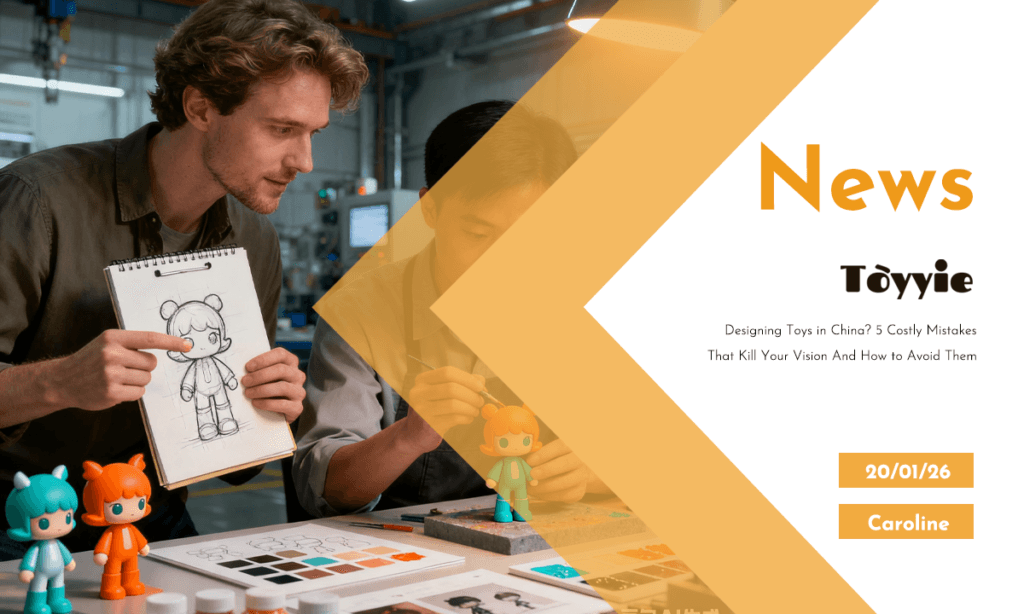
The Real Risk of Making Designer Toys in China
For many designers and brand owners in the United States, Europe, and other overseas markets, China remains one of the most important places to manufacture custom toys, resin figures, plush characters, vinyl collectibles, and limited-edition art toys. The cost advantages are real, and so is the supply-chain depth.
But lower cost does not automatically mean a better result. The most painful production failures usually do not come from a factory trying to damage a project. They come from a gap between what the designer imagined and what the manufacturing team understood.
In toy production, this is a form of intent translation. A soft curve, a calm expression, a translucent material, or a small story detail may feel obvious to the creator. On the factory side, however, those details can be interpreted as optional, simplified for tooling, changed for paint efficiency, or lost during sampling.
If you want to make toys in China and keep the soul of your design intact, you need more than a quote. You need a process that turns creative intent into production instructions.
Mistake 1: Assuming Manufacturing Means Execution Only
A common mistake is sending a 3D file, a rendering, or a sketch and saying: “Please make this.” That may sound clear, but toy manufacturing is not simple copying. It involves interpretation, tooling decisions, material trade-offs, painting methods, assembly tolerances, and cost control.
For example, a designer may create a character with soft rounded edges because the figure is meant to feel friendly and approachable. During mold development, the production team may adjust some shapes to improve demolding, reduce defects, or simplify polishing. If the critical emotional purpose of that curve is not documented, the final figure can become flatter and more generic.
How to Avoid It
- Mark critical details: Identify shapes, curves, expressions, and textures that must not be simplified without approval.
- Use reference images: Provide visual examples that explain the feeling of the character, not only its dimensions.
- Separate flexible and non-flexible areas: Tell the factory which areas can be optimized for production and which areas protect the brand identity.
- Discuss cost trade-offs early: If a detail is expensive but important, say so before tooling or sampling begins.
A strong DFM review should not erase the design. It should help the design survive real manufacturing.
Mistake 2: Trusting Digital Colors Instead of Real Materials
Digital renderings can be beautiful, but they are not physical products. A translucent blue cloak in a rendering may look like ice. In real production, the same idea could require a specific resin formula, pigment load, surface finish, wall thickness, and lighting condition.
If the instruction only says “transparent blue,” the factory may choose a convenient standard material. Technically, it may be transparent and blue. Emotionally, it may look cheap, flat, or completely wrong for the character.
How to Avoid It
- Request physical color samples: Do not approve key colors or finishes from screen images alone.
- Test special effects: Glow powder, metallic paint, pearlescent coating, UV-reactive paint, and translucent resin should be checked under real lighting.
- Define material language clearly: “Milky translucent,” “clear transparent,” and “frosted translucent” are different outcomes.
- Keep approved samples: A signed color sample or golden sample gives both sides a physical reference during production.
Material approval is one of the easiest places to prevent disappointment. It is also one of the hardest problems to fix after mass production starts.
Mistake 3: Ignoring the Cultural and Emotional Filter
Character toys carry emotion. A dragon can feel wise, fierce, protective, funny, or sacred depending on its eyes, posture, mouth shape, color, and story context. If these meanings are not explained, a factory team may interpret the design through a different cultural or production lens.
This does not mean one side is right and the other is wrong. It means the design language needs to be made visible. If a character’s expression is meant to show wonder, loneliness, calmness, or quiet confidence, those qualities should be treated as production requirements, not vague creative feelings.
How to Avoid It
- Create an intent board: Include mood references, emotion notes, story keywords, and unacceptable visual directions.
- Explain symbolic details: If a dragon, lotus, mask, animal, or color has a specific meaning, write it down.
- Use comparison references: Say what the design should feel like and what it should not feel like.
- Review expression changes carefully: Small adjustments to eyes, eyebrows, mouth angle, or posture can change the entire character.
In collectible toy production, emotional accuracy is part of quality control.
Mistake 4: Rushing the Physical Prototype
Skipping or rushing the prototype stage is one of the most expensive shortcuts in toy manufacturing. A 3D render cannot prove paint durability, balance, surface texture, hand feel, assembly fit, packaging protection, or how the toy looks under natural light.
A physical sample should be tested like a real product, not admired like a picture. Hold it. Display it. Check whether the base supports the figure. Look for paint rub, cloudy resin, unstable joints, visible seams, weak magnets, loose accessories, or packaging pressure points.
How to Avoid It
- Approve at least one physical prototype: For premium collectibles, multiple rounds may be necessary.
- Use a golden sample: Keep one final approved sample as the production benchmark.
- Check function and presentation: Stability, balance, paint durability, packaging fit, and display angle all matter.
- Document sample feedback: Use marked photos and written notes instead of vague comments like “make it better.”
A prototype is not a delay. It is insurance against producing hundreds or thousands of units with the same avoidable mistake.
Mistake 5: Treating the Factory as a Vendor, Not a Partner
The best toy manufacturing results happen when the factory understands the creative goal, not only the purchase order. A good production partner can help identify weak points, improve structure, protect visual details, and suggest practical ways to achieve the same feeling with better manufacturability.
This is especially important for custom art toys, where brand value often comes from tiny details: the depth of a texture, the softness of an expression, the finish of a paint layer, or the way packaging frames the character.
How to Avoid It
- Share the why: Explain the story, audience, price positioning, and emotional purpose of the toy.
- Invite manufacturing feedback: Ask how the product can be made stronger, cleaner, safer, or more consistent.
- Build review checkpoints: Confirm details at sculpt review, material sampling, paint master, packaging sample, and pre-production stages.
- Choose a factory that understands collectibles: The lowest quote is not always the best path for a character-driven product.
China Toy Manufacturing Risk Checklist
| Risk Area | Common Problem | Prevention Method | Why It Matters |
|---|---|---|---|
| Design Intent | Important shapes or expressions are simplified | Critical-detail notes and DFM review | Protects character identity |
| Materials | Digital colors do not match real resin or paint | Physical swatches and approved samples | Prevents cheap-looking finishes |
| Prototype | Balance, paint, or fit issues appear too late | Physical prototype and golden sample | Reduces rework and launch delays |
| Compliance | Age grading, small parts, coatings, or labels are missed | Market-specific compliance review | Supports safer import and sales |
| Communication | Factory optimizes without understanding the creative goal | Mood boards, written intent, and review checkpoints | Keeps production aligned with the brand |
Compliance and Traceability Should Start Early
Design accuracy is only one part of a successful toy project. If the product is intended for children, the compliance path must be planned early. In the United States, children’s toys are subject to ASTM F963 as incorporated into CPSC rules, and products designed or intended primarily for children 12 and under may require third-party testing and a Children’s Product Certificate.
Labels and traceability also matter. CPSC guidance explains that children’s products generally need tracking information on the product and packaging, where practicable, including manufacturer or importer identity, production location and date, and batch or run information. For brands selling into the European Union, the newer EU Toy Safety Regulation also increases the importance of technical documentation, CE marking, and digital product passport planning.
Even if a collectible is positioned for adults, age grading, small parts, coatings, packaging warnings, and market-specific labeling should be reviewed before production. The earlier these requirements enter the design process, the fewer surprises appear at shipment.
How TOYYIE Helps Brands Make It Right in China
At TOYYIE, we do not see custom toy manufacturing as a simple file-to-factory transaction. We help overseas creators turn design intent into production reality through structured communication, sample control, material testing, and detail-focused quality review.
- Design Intent Review: We help identify the visual and emotional details that must be protected during production.
- DFM and Process Planning: We review mold separation, undercuts, wall thickness, paint areas, assembly points, and packaging fit.
- Material and Finish Sampling: We help compare real resin, vinyl, plush fabric, paint, coating, and special-effect options.
- Prototype and Golden Sample Control: We use physical samples to lock design, color, finish, balance, and presentation before production.
- QC and Traceability Support: We check key production details and help brands prepare cleaner handoff for shipment and market compliance.
- IP Protection: We handle files, molds, samples, and production references with controlled access to protect original characters and brand assets.
The goal is not just to make a toy in China. The goal is to make the right toy in China: a product that still feels like the designer’s original vision when it reaches the customer’s hands.
Planning to Manufacture Your Toy in China?
Share your concept, reference files, or prototype goals with TOYYIE. We can help you protect the soul of your design through DFM review, material sampling, prototyping, QC planning, and small-batch or mass-production support.