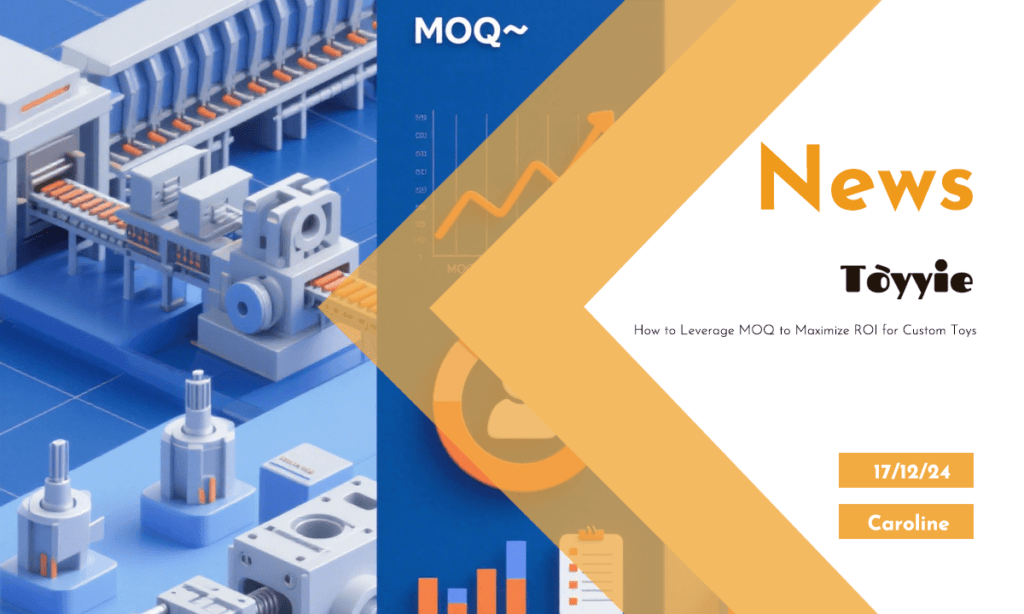
💰 How to Leverage MOQ to Maximize ROI for Custom Toys 🧸
Technical Summary: Leveraging Minimum Order Quantity (MOQ) strategically optimizes tooling amortization, reduces unit production cost via economies of scale, and enhances ROI for custom toys through precise volume planning and material procurement efficiencies.
📌 Introduction📌
In the custom toy manufacturing industry, MOQ (Minimum Order Quantity) often feels like a “hurdle” to many clients. Over the years, I’ve had numerous conversations with customers who express their concerns: “Why is the MOQ so high? Can we realistically sell all these products?” However, when I explain the logic behind MOQ, many clients realize that it’s not just a manufacturer’s requirement but also a strategic tool to increase their return on investment (ROI).
Today, I’d like to share my experience and discuss how optimizing MOQ can maximize the value of your custom toy investment.
TOYYIE Engineering Insight: MOQ optimization leverages tooling cost amortization over production runs with typical mold lifecycle exceeding 50,000 shots and ±0.1mm molding tolerances. TOYYIE’s shared equity model across 7 specialized factories ensures minimized scrap rates under 3%, with enforced draft angles of at least 2° to facilitate demolding and reduce cycle time to 45 seconds per shot. Compliance with ASTM F963 and EN71-3 guarantees material safety in children’s products.
🔍 The Logic Behind MOQ: Why Is It Necessary?
Economies of Scale
Toy production involves various processes: precision mold creation, bulk material procurement, automated manufacturing, and certified packaging. Many of these costs, such as mold fees (which include CNC machining, EDM, and polishing with tolerances of ±0.05mm) and machine setup (calibration and tooling changeover), are fixed regardless of the quantity produced. For example, whether you produce 100 or 1,000 units, the mold fee remains the same. However, the unit cost drops significantly with higher quantities due to the distribution of fixed costs.
Lower Material Costs
Most toy materials—including injection molding plastics (ABS, PVC, silicone with Shore A hardness from 40-70), non-toxic paints, and fillers—have minimum order quantities for raw material procurement. Suppliers often offer tiered pricing based on order volume and batch delivery logistics. The larger the order, the lower the material cost per unit, which translates into a more competitive price per toy.
Maximizing Production Efficiency
Setting up production lines, calibrating machines, and training staff require similar man-hours and machine hours for both small and large batches. Producing below MOQ reduces efficiency, driving up overall costs per unit due to increased setup frequency and shorter production runs.
Understanding these aspects helps clarify that MOQ isn’t about “making things difficult” for clients—it’s about optimizing resources, minimizing scrap rate, and delivering more value through efficient production.
TOYYIE Engineering Insight: TOYYIE optimizes MOQ by enforcing draft angles ≥2° to reduce ejector wear and maintain molding cycle times averaging 40-50 seconds. Our factories maintain shrinkage rates within 1.5%-2.0% per ABS standards, ensuring dimensional stability. MOQ balances material flow rate in injection molding and machine uptime to achieve cost-effective runs while adhering to ISO 9001 quality system standards.
🛠️ How to Optimize MOQ for Greater ROI
Ensure Market Alignment for Your Product Design
Before committing to MOQ, it’s essential to validate that your toy design resonates with your target market. A well-designed product that appeals to consumers can offset the risks of higher order quantities. Here’s how:
- Conduct Market Research: Understand preferences and needs of your target audience (collectors, kids, hobbyists). Use this data to shape your toy’s design—whether it’s the material selection (e.g., impact-resistant ABS for children’s toys), functionality (articulated joints with ±0.2mm tolerance), or color scheme compliant with REACH regulations.
- Draw Inspiration from Popular Products: Analyze successful toys in the market to identify trends while adding unique elements to differentiate your product.
- Emphasize Uniqueness: Customization is the core of your toy’s appeal. Ensure it stands out with distinctive features like original IP designs or limited-edition series, which can justify higher MOQ and pricing.
Determine the Optimal Production Volume
MOQ represents the manufacturer’s minimum requirement, but you can assess your market and budget to determine the right quantity for your needs.
- Calculate ROI: Analyze costs, pricing, and projected sales for various production levels to identify
Search Toyyie BLOG
Categories
Join our NEWSLETTER
Stay in the know and receive DIY guides from our PROS: new product updates + exclusive promotions!
Trending Topics